

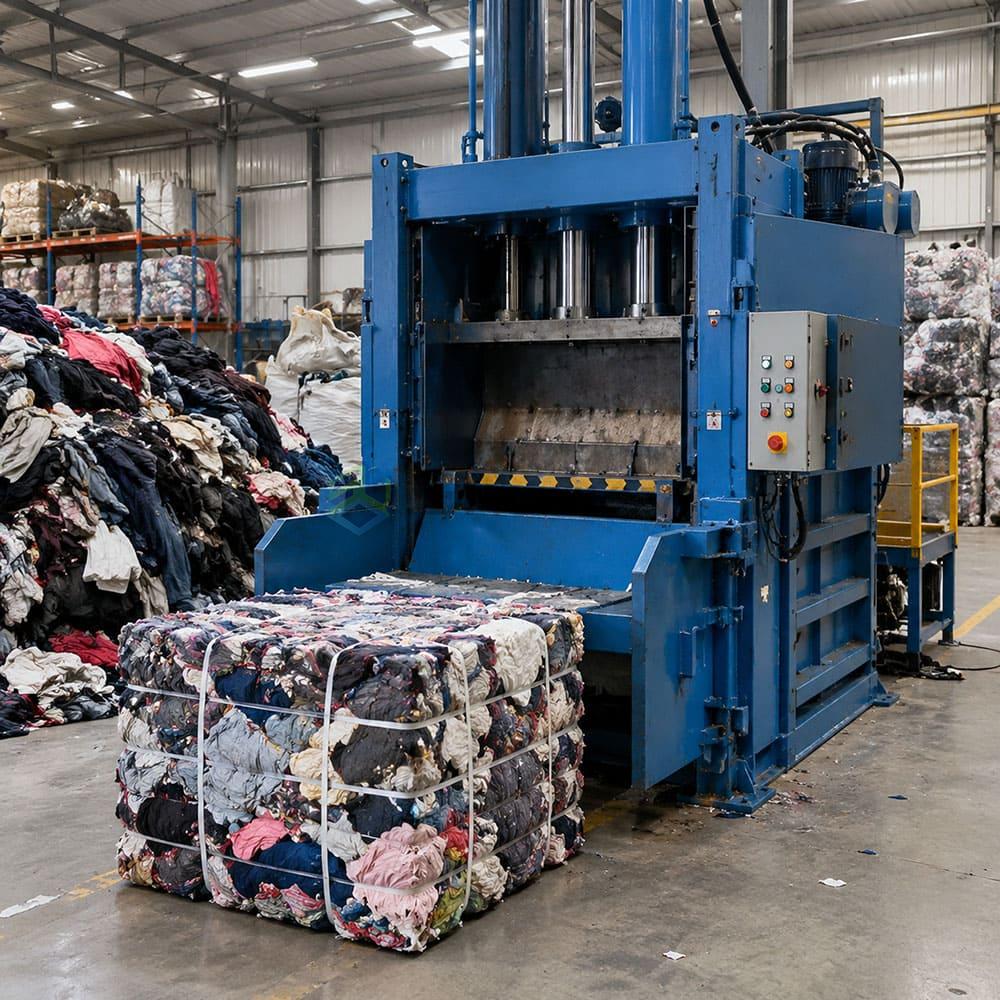
A baler machine for clothes compresses loose used clothing or textile waste into manageable bales tied for efficient storage, handling, and transportation. If you've considered one, you know it's more than a simple compactor—choosing the right baler requires understanding material condition, throughput needs, and bale size requirements.
A baler machine for clothes is designed to compress sorted, dry used clothing or textile waste into tightly bound bales optimized for storage and transportation. It supports recycling and waste-handling workflows by reducing storage volume and simplifying logistics.1 Material preparation and sorting are critical before baling to ensure quality and machine compatibility.
However, getting into the details matters—because every buyer's material and operational needs differ. Let's explore how clothes balers work, why material preparation matters, and what key factors you should evaluate before making a purchase.
How does a baler machine for clothes work?
A baler for clothes functions as a volume-reduction machine, compressing loose clothing into dense, tied bales.
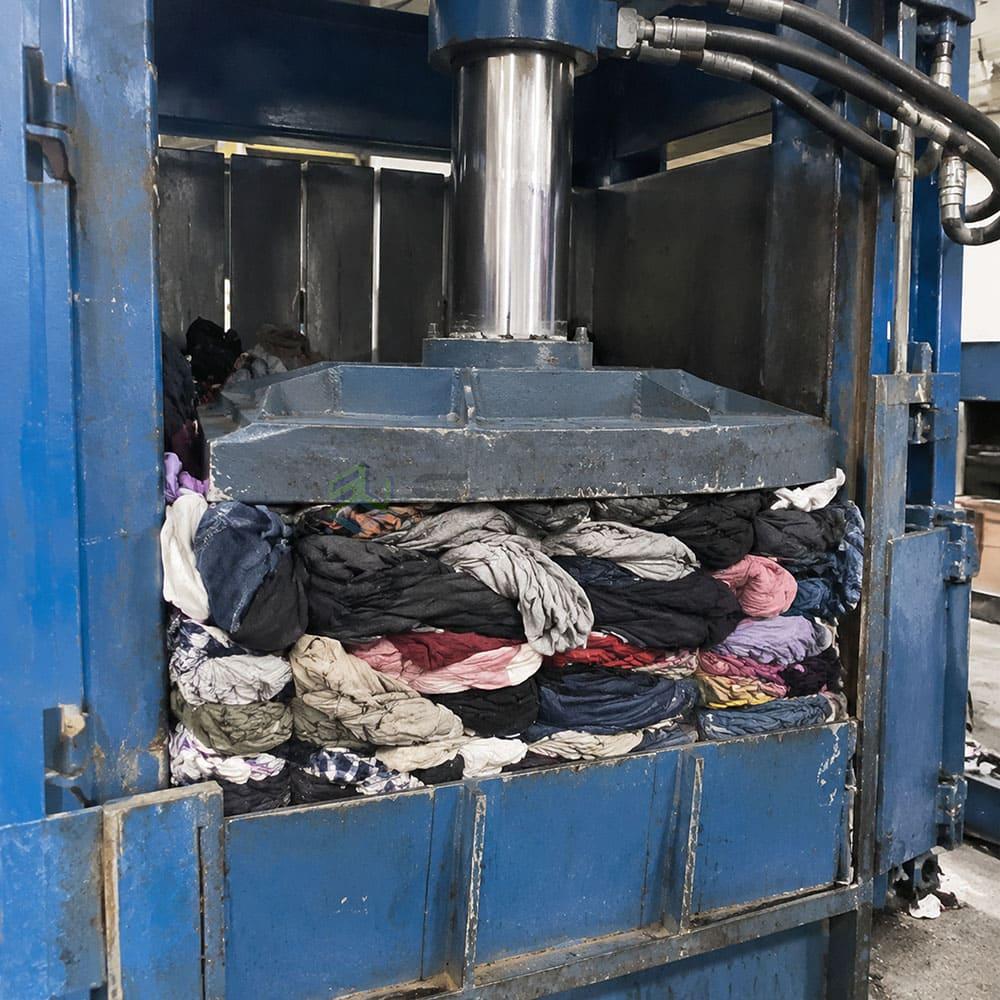
It works by compressing textiles or used garments using hydraulic force, forming dense, uniform bales for storage and transport.2 Typically, operators load clothing into the machine's chamber, and the hydraulic system applies force to compress the materials before tying them into bales.
Dive deeper: Process breakdown
The operation of a clothes baler typically has five phases:
- Loading: Operators place sorted, dry textile waste or clothing into the machine’s compression chamber. Sorting ensures the bales have uniform material characteristics while removing contaminants or hard objects.3
- Compression: A hydraulic ram applies force to pack clothing or textiles tightly, reducing volume substantially.
- Binding: Once compressed, the machine ties the material with straps or wires to stabilize the bale shape during handling, storage, or transport.4
- Ejection: The completed bale is ejected from the chamber and can be moved to a storage area.
- Adjustment: Depending on configurations, the machine allows changes to bale size, density, or weight. Larger machines cater to higher throughput needs while compact balers fit smaller-scale operations.
While the operation sounds simple, the real challenge lies in material preparation and choosing the right machine for the intended workflow.
Why is preparation before baling so important?
Material preparation is crucial for ensuring baling consistency, avoiding moisture risks, and protecting the machine during operation.
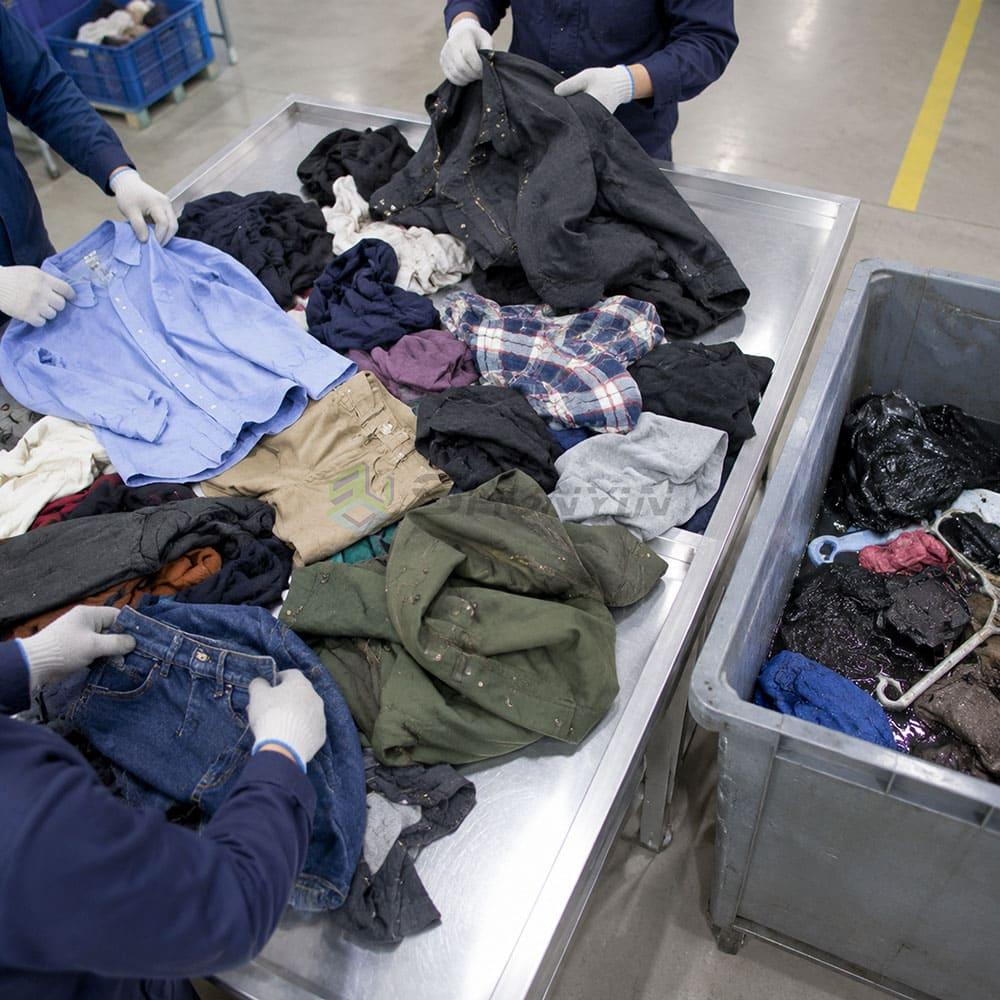
Clothing for baling must be sorted to separate unsuitable items like wet fabrics or garments with hard components. Wet clothes can lead to mold issues, while hard objects like buttons or zippers can reduce bale uniformity and affect machine performance.
Dive deeper: Sorting, dryness, and hard components
Before compressing clothing or textiles into bales, certain preparatory steps must take place:
- Sorting by material type: Textile waste varies significantly—stretch fabrics, cotton, synthetics, and blended textiles compress differently.5 Sorting ensures uniform bales.
- Checking moisture levels: Moisture retention in textiles can cause mildew or mold during storage.6 Wet clothing should dry fully before processing.
- Removing hard components: Zippers, buttons, or metal hard objects may damage or create deformed bales.7 Sorting out these garments prevents issues during compression.
For instance, one Australian customer initially assumed their baler could handle unsorted clothing directly. However, after understanding how moisture and hard components deteriorate bale quality, they adopted comprehensive sorting protocols before baling—and achieved better consistency with fewer operational issues.
What factors influence clothes baler selection?
Choosing the right baler depends on key criteria like material condition, throughput requirements, and desired bale specifications.
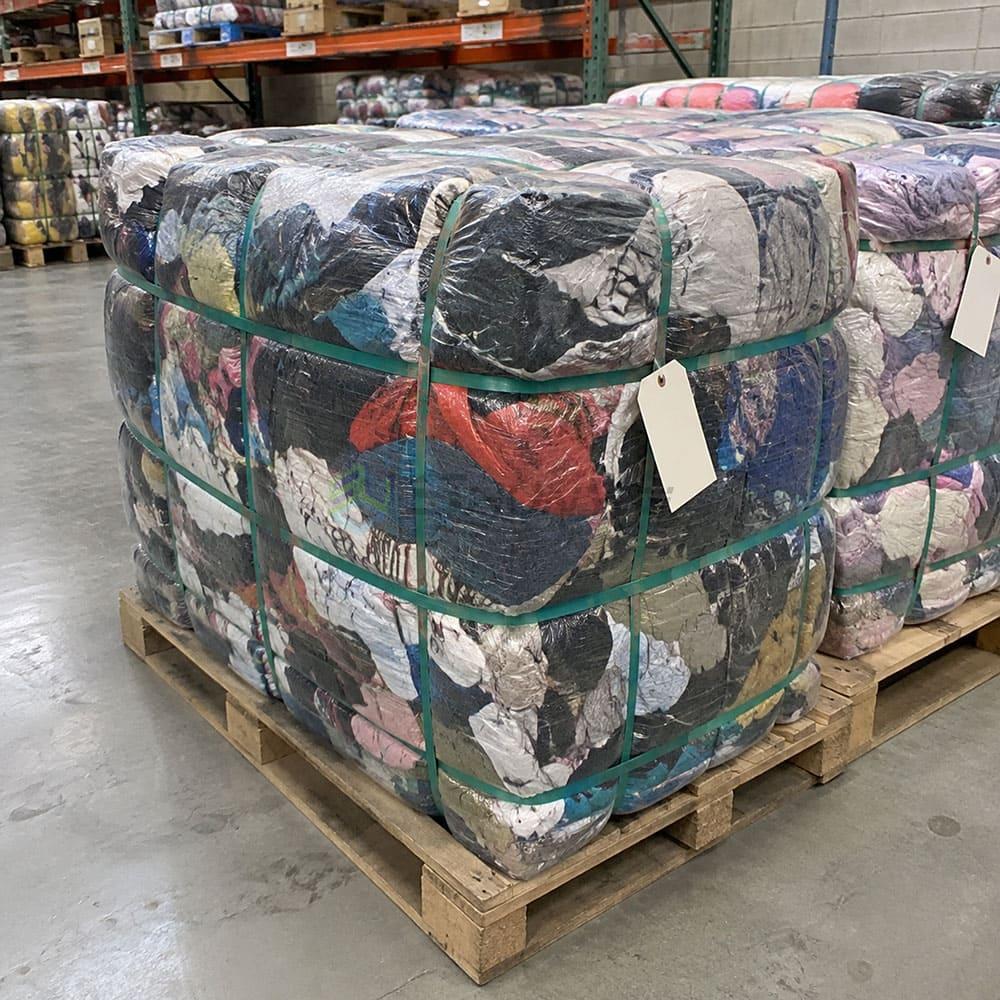
Evaluate clothing balers based on three critical questions: What type of clothing or textile waste is being baled? What throughput does the operation require? What size, weight, and shape of bales align with your transportation methods?
Dive deeper: Buyer evaluation guidelines
When deciding on a baler for used clothing or textile waste, key factors to examine include:
- Material condition: Textile characteristics—soft, rigid, mixed—and whether the materials are sorted or unsorted. Wet materials should never enter the baler.
- Throughput needs: Daily or hourly compression capacity should suit your operational scale. Machines range from low-volume models for smaller textile handlers to large hydraulic horizontal balers for high-volume recyclers.8
- Bale dimensions: Storage and transport logistics dictate your preferred bale size, weight, and density.9 Are your buyers or logistics partners equipped to handle the packaged textiles effectively?
Practical example: An Australian customer’s experience
I once worked with an Australian textile recycling customer unsure whether unsorted clothing could go directly into the baler. Once advised on sorting for moisture and removing garments with hard components, they purchased a baler suited to their materials and adjusted bale dimensions for their freight containers. Within months, they reported improved material handling due to consistent bale quality, though results always depend on operational discipline.
FAQs
Can wet clothing be baled?
No, wet clothing should not be baled immediately. Moisture can lead to mold or mildew inside dense bales during storage or transportation. Dry materials thoroughly before compression.
Is baling suitable for mixed clothing materials?
Yes, but only after sorting. Mixed textiles compress differently, and unsorted mixtures risk creating irregular bales with variable density.10 Sorting ensures uniformity and reduces storage and logistical issues.
What bale size works best for transportation?
The optimal bale size depends on your transport method and storage arrangement. Many buyers prefer rectangular bales fitting standard freight pallets or containers, with weights adjusted for manual or mechanized handling.11
Can hard objects like buttons or zippers damage the baler?
Yes, hard components can reduce bale quality and, in some cases, damage the compression chamber. Always sort out garments with hard objects before baling to protect the equipment and ensure uniform bale shape.
Do clothing balers automatically sort materials?
No, balers themselves do not sort textiles.12 Material sorting is a pre-compression stage handled by the operators or additional equipment where needed.
Conclusion
A baler machine for clothes is a powerful solution for compressing used garments or textile waste into manageable bales. However, success depends on preparation—sorting materials, ensuring dryness, and evaluating bale specifications for your transport and storage needs. These machines are indispensable for recycling workflows when properly chosen and operated.
If you're exploring clothes balers for your operation, let's discuss your material type, throughput needs, and logistics requirements to recommend the right solution. Connect with us today to start evaluating options!
"Evaluation Of Solid Waste Baling and Balefills, Volume 1 ...", https://nepis.epa.gov/Exe/ZyPURL.cgi?Dockey=2000TC07.TXT. Waste-management guidance identifies baling as a volume-reduction process that consolidates loose material for more efficient storage, handling, and transportation; the magnitude of the benefit varies with material properties and achieved bale density. Evidence role: general_support; source type: government. Supports: Government or institutional waste-management guidance should confirm that baling reduces the volume of loose materials and facilitates their storage, handling, or transport.. Scope note: General waste-baling guidance may not provide results specific to used clothing. ↩
"Operating Hazards of Baler Discharge-Door Locks", http://www.osha.gov/publications/shib081313. Technical descriptions of hydraulic balers explain that hydraulic pressure drives a ram or platen against material in a chamber, compacting it before the load is secured and removed; this establishes the operating mechanism but does not guarantee uniform density for every textile feedstock. Evidence role: mechanism; source type: government. Supports: An engineering or safety source should document that hydraulic balers use a powered ram to apply compressive force to material in a chamber.. Scope note: The source may describe industrial balers generally rather than clothing-specific models. ↩
"Chemical Valorization of Textile Waste - PMC - NIH", https://pmc.ncbi.nlm.nih.gov/articles/PMC11966312/. Textile-recycling literature treats sorting by composition, condition, and contamination as a key preprocessing step for producing more consistent material streams; this supports presorting before baling, although it does not by itself quantify improvements in bale uniformity. Evidence role: general_support; source type: research. Supports: Research or institutional guidance should show that textile recycling relies on sorting by composition, condition, or contamination to create more consistent input streams.. Scope note: Evidence about recycling-feedstock quality is contextual rather than direct proof of a specific bale-quality outcome. ↩
"Validation of Field Test Methods for Use of Tire Bales", https://library.ctr.utexas.edu/ctr-publications/5-5517-01-1.pdf. Baling references describe wire or strapping as the restraint that holds compacted material after pressure is released, thereby preserving bale integrity during handling and storage; actual stability also depends on binding strength, placement, and material rebound. Evidence role: mechanism; source type: education. Supports: A technical source should explain that binding material counteracts expansion after compression and preserves bale integrity during handling.. Scope note: This mechanism is general to bound bales and does not establish the suitability of a particular strap or wire for textiles. ↩
"Quality of clothing fabrics in terms of their comfort properties", https://www.academia.edu/86979506/Quality_of_clothing_fabrics_in_terms_of_their_comfort_properties. Studies of textile compression show that compressibility and recovery vary with fiber composition, fabric structure, thickness, and mechanical resilience, supporting the expectation that cotton, synthetic, stretch, and blended materials will not respond identically to pressure. Evidence role: mechanism; source type: paper. Supports: Materials research should show that fiber composition, fabric structure, thickness, and resilience influence textile compression and recovery.. Scope note: Laboratory measurements on individual fabrics may not directly predict the behavior of heterogeneous, full-scale clothing bales. ↩
"Mold and Mildew on Textiles", https://mci.si.edu/mold-and-mildew-textiles. Textile-conservation guidance identifies elevated moisture and prolonged dampness as conditions that promote mold growth on fabrics in storage; the precise risk depends on humidity, temperature, exposure time, and the presence of viable spores. Evidence role: mechanism; source type: institution. Supports: A conservation or microbiology source should establish that damp conditions promote fungal growth on textile materials during storage.. Scope note: The evidence establishes a general moisture-related risk rather than a universal outcome for every damp bale. ↩
"1926.403 - General requirements.", http://www.osha.gov/laws-regs/regulations/standardnumber/1926/1926.403. Baler safety and operating guidance warns that incompatible or rigid foreign objects can obstruct the compression cycle, create uneven loads, or damage equipment; whether ordinary garment buttons or zippers present a material risk depends on their size, construction, concentration, and the machine's design limits. Evidence role: general_support; source type: government. Supports: Safety or operating guidance should confirm that incompatible rigid objects can obstruct compaction or damage baler components.. Scope note: General warnings about foreign objects do not prove that every button or zipper will damage a clothing baler. ↩
"(PDF) The Design and Fabrication of a Horizontal Hand Baler", https://www.academia.edu/65946065/The_Design_and_Fabrication_of_a_Horizontal_Hand_Baler. Technical overviews distinguish compact or vertical balers used in lower-volume settings from larger horizontal systems designed for higher and often more continuous throughput; capacity nevertheless varies substantially within each configuration. Evidence role: general_support; source type: education. Supports: A technical source should distinguish lower-throughput vertical balers from larger horizontal or automated systems designed for continuous, higher-volume use.. Scope note: Machine orientation alone does not determine capacity, and textile-specific performance also depends on feedstock and operating conditions. ↩
"Compilation of Existing State Truck Size and Weight Limit Laws", https://ops.fhwa.dot.gov/freight/policy/rpt_congress/truck_sw_laws/app_a.htm. Unit-load and material-handling guidance states that package dimensions and mass should be coordinated with storage geometry, handling equipment, and vehicle constraints; for textile bales, density additionally affects how much material occupies a given transport volume. Evidence role: general_support; source type: education. Supports: Logistics research should establish that unit-load dimensions and weight must be compatible with storage systems, handling equipment, and vehicle capacity.. Scope note: General unit-load principles do not specify a universally optimal clothing-bale size. ↩
"Textile waste reinforced cementitious composites - PMC - NIH", https://pmc.ncbi.nlm.nih.gov/articles/PMC13476324/. Research showing composition-dependent differences in textile compressibility provides a mechanical basis for density variation in heterogeneous bales; however, without full-scale baling trials, it does not directly establish that every unsorted mixture will form an irregular bale. Evidence role: mechanism; source type: paper. Supports: A study should show either directly that heterogeneous textile feedstocks create variable compaction outcomes or indirectly that constituent fabrics have materially different compression properties.. Scope note: Support may be inferential if the source tests fabrics rather than complete mixed-clothing bales. ↩
"transforming the structure of the freight transport sector", https://www.oecd.org/content/dam/oecd/en/publications/reports/1995/09/transforming-the-structure-of-the-freight-transport-sector_g1g30534/9789282105535-en.pdf. Cargo-transport guidance emphasizes matching package geometry and mass to pallets, container interiors, load distribution, and handling equipment, which provides a logistical rationale for rectangular bales with controlled dimensions and weight; it does not establish how common this preference is among clothing buyers. Evidence role: general_support; source type: institution. Supports: Freight or cargo guidance should establish that packaged-load geometry and weight must be compatible with pallets, cargo transport units, and mechanical or manual handling limits.. Scope note: The evidence supports compatibility considerations, not the unquantified claim that many buyers share a particular preference. ↩
"Science & Tech Spotlight: Textile Recycling Technologies", https://www.gao.gov/products/gao-24-107486. Textile-recycling process descriptions treat sorting and baling as distinct operations: sorting identifies or separates materials, whereas baling compacts the resulting streams for storage or shipment; integrated processing lines may connect both operations without making the baler itself a sorting device. Evidence role: definition; source type: research. Supports: A textile-recycling process source should distinguish sorting systems, which classify or separate materials, from balers, which compact prepared material.. Scope note: The categorical statement applies to conventional balers and allows for facilities that integrate separate sorting technology with a baling line. ↩