

A cardboard baler compresses large volumes of cardboard waste into dense, manageable bales for easier storage, transportation, and recycling.1 Understanding how these machines operate is crucial for selecting a baler that fits your workflow, space, and labor availability. But the process itself is straightforward compared to deciding which type of baler aligns with your operational needs.
Cardboard balers work by compressing loose cardboard into dense bales using hydraulic pressure inside a chamber.2 Cardboard is fed into the baler through manual or automated systems, compressed by a hydraulic ram, tied into a bale using twine or wire, and discharged for storage or transport. Choosing the right baler depends on your material volume, labor, and automation needs.
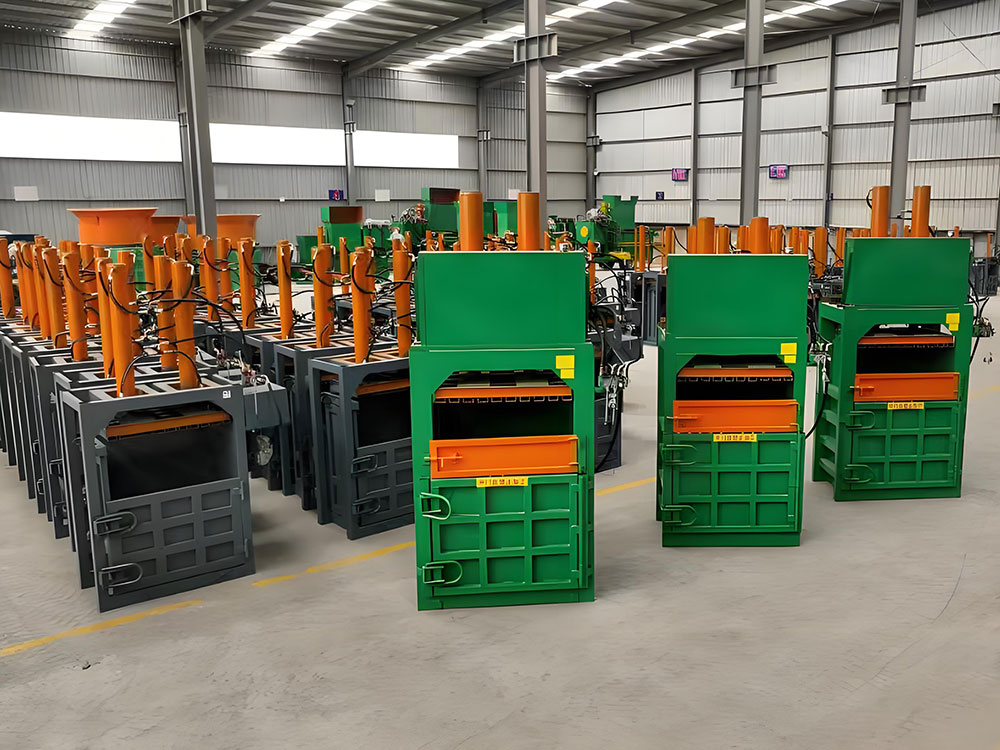
While this cycle underpins all cardboard balers, the decision-making behind vertical versus horizontal balers—and the level of automation—is key to optimizing efficiency. Let’s break it down further.
What is the basic baling cycle?
The problem: Efficiently compressing loose cardboard waste.
The agitation: Messy workflows cost time, labor, and space without proper equipment.
The solution: A cardboard baler performs a repetitive cycle to compress, bind, and discharge cardboard for recycling.
The basic baling cycle includes material feeding into the chamber, hydraulic compression, bale tying, and bale discharge.3 Feeding methods and automation levels will vary between baler types.
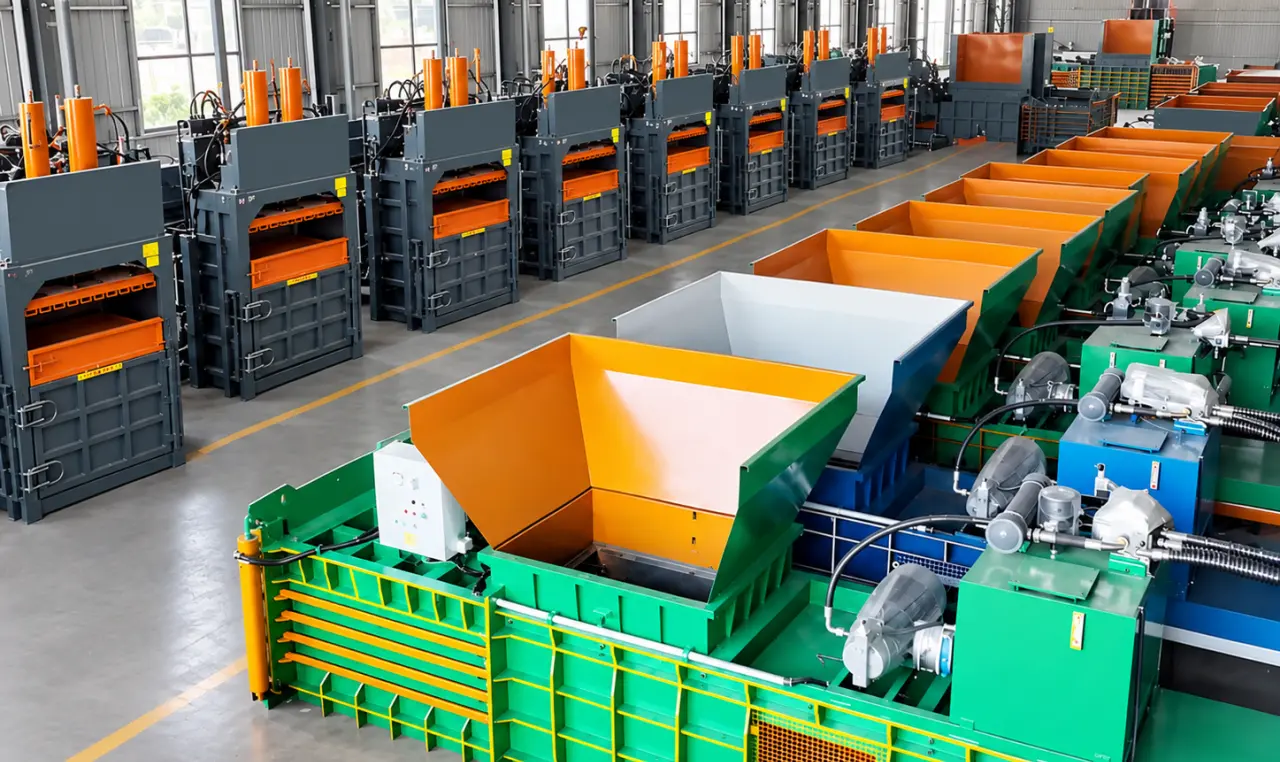
The baler’s cycle can be broken into four simple steps:
- Feeding: Loose cardboard is loaded directly or conveyed into the compression chamber.
- Compression: A hydraulic ram presses the cardboard into dense blocks.
- Tying: The compacted cardboard is then tied securely using wire or twine.
- Discharge: The finished bale is ejected for handling and transport.
Vertical balers follow this same logic but often rely on more manual labor for feeding, tying, and bale removal, whereas horizontal balers automate sections of this cycle for higher throughput.4
Vertical vs. horizontal balers: how do workflows compare?
The problem: Many buyers overlook workflow differences when evaluating baler types.
The agitation: Misaligned baler choice can create bottlenecks or require excess labor.
The solution: Understand how your material volume and feeding continuity shape the choice between vertical and horizontal balers.
Vertical balers generally suit lower volumes and manual workflows, while horizontal balers are ideal for continuous feeding and automation in high-volume applications.5 Both types have distinct advantages depending on labor availability and operational scale.
-
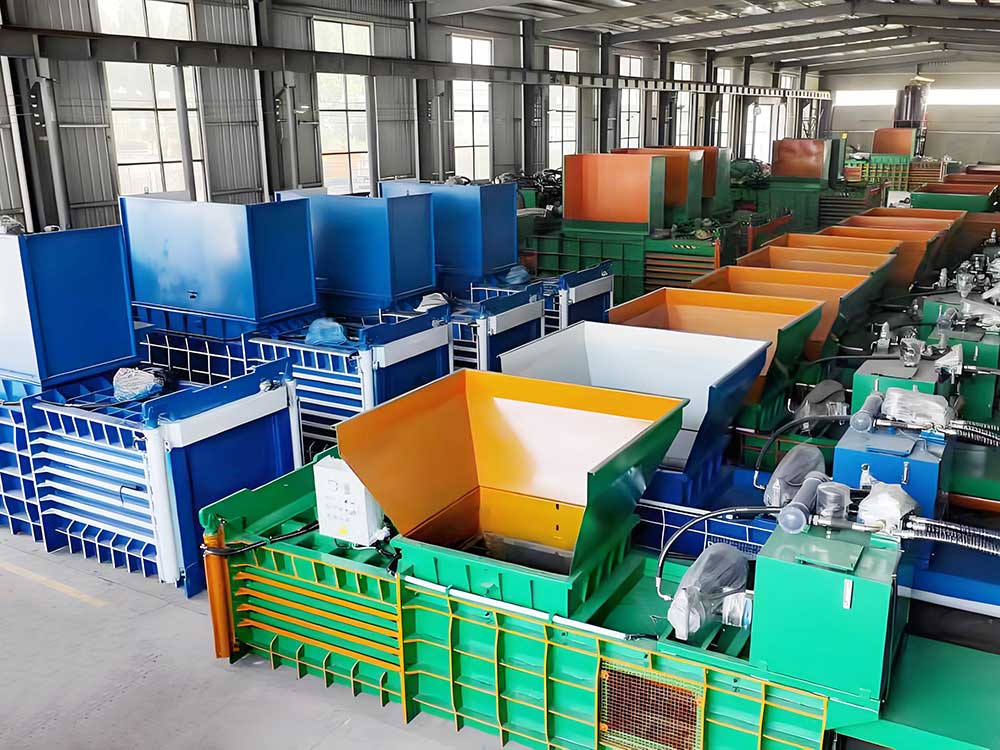
Vertical balers: Compact and cost-effective. Operators manually load cardboard into a top-loading chamber, activate the hydraulic press, tie off bales, and manually remove and store them. Suitable for smaller operations with lower cardboard throughput.
-
Horizontal balers: Larger and higher-capacity systems designed for continuous feeding—either by conveyor, forklift, or automatic systems. These machines typically tie and eject bales automatically, reducing manual intervention and supporting high-volume workflows.6
Here’s an illustrative comparison:
| Feature | Vertical Balers | Horizontal Balers |
|---|---|---|
| Ideal material volume | Low to moderate | Moderate to high |
| Feeding method | Manual loading | Conveyor or automated |
| Labor requirements | Higher | Lower |
| Bale size | Smaller | Larger |
| Floor space required | Minimal | Significant |
| Level of automation | Limited | Advanced |
In customer consultations, I often see buyers gravitate toward vertical balers because of their lower upfront cost. However, a clear evaluation of workflow made all the difference for one of our Mexican clients.
Does automation always improve baler efficiency?
The problem: Automation is often seen as universally better.
The agitation: Automation adds value in the right context, but excess capacity adds cost without solving specific workflows.
The solution: Base automation choices on your cardboard volume, labor availability, and floor space—not on wishful cost savings.
Automation improves baler efficiency by increasing throughput and reducing manual labor, but it’s only worthwhile if your intake volume and workflows align with the machine's capabilities.7
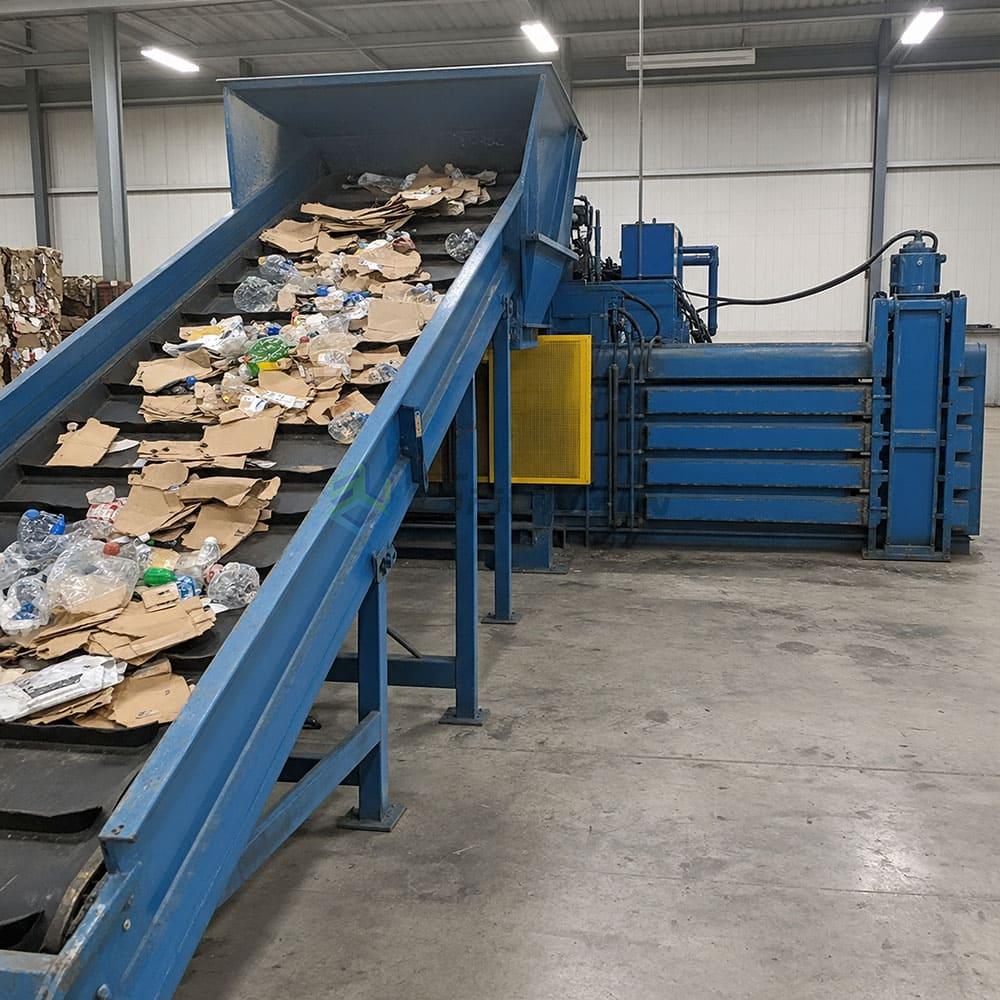
Take the example of a Mexican recycling facility that planned to install several vertical balers for cardboard processing. My consultation revealed that manual loading, tying, and discharge would require dedicated labor at each machine, likely creating bottlenecks. Instead, the customer opted for one fully automatic horizontal baler. The new setup allowed continuous feeding and automated bale tying, freeing operators for other tasks.
That decision exemplifies how evaluating workloads can make automation a practical investment, not just an idealized solution. However, the additional footprint and complexity of horizontal systems are unnecessary for small-scale or intermittent cardboard processing unless your facility has a strong automation strategy.8
Factors to evaluate before choosing automation:
- Daily cardboard volume: Does your intake justify continuous feeding?
- Labor availability: Will operators be strained by manual steps in vertical systems?
- Floor space constraints: Do you have the room for larger horizontal or automated systems?
- Budget vs workflow trade-offs: Will automation save enough labor to justify the cost?
Frequently Asked Questions
Does cardboard baler size affect bale quality?
Not necessarily. Bale quality depends more on compression force, tying mechanism, and hydraulic consistency than the size of the baler itself.9
How much floor space does a horizontal baler need?
Horizontal balers typically require significant floor space—both for the machine itself and for supporting elements like conveyors or additional feeding systems.10 Vertical balers are compact alternatives.
What’s the best baler for intermittent cardboard processing?
If you have low, inconsistent cardboard volume, vertical balers are a cost-effective choice. They offer manual operation and save floor space for occasional use.
Can horizontal balers handle other materials besides cardboard?
Yes, many horizontal balers are multipurpose machines capable of compressing other recyclable materials, such as plastic film, paper, and textiles.11 Confirm compatibility with your intended materials before purchasing.
How long does installation typically take for balers?
Installation timelines vary by model. Simple vertical balers may only take a day, while larger, automated horizontal balers require several days for setup, testing, and conveyor integration.12
Conclusion
A cardboard baler works by compressing loose cardboard into secure, manageable bales, but selecting the right machine involves more than understanding the compression cycle. Key considerations include material throughput, feeding efficiency, labor availability, and budget constraints. I’ve seen buyers transform workflows by aligning baler type—vertical or horizontal—with their real-world needs. If you’re ready to discuss your facility's requirements in detail, I’d be happy to help you explore the options. Reach out to learn more!
"A Guide to Waste Reduction at Shopping Centers", https://nepis.epa.gov/Exe/ZyPURL.cgi?Dockey=30006HWF.TXT. Waste-management guidance identifies baling as a means of reducing the volume of loose recovered paper and facilitating storage and transport, although the resulting logistical benefit depends on bale density and local collection arrangements. Evidence role: general_support; source type: government. Supports: Waste-management guidance should confirm that baling reduces the volume of loose cardboard and facilitates its storage, handling, and transportation.. Scope note: The magnitude of the benefit varies with bale density, handling equipment, and transport practices. ↩
"Massachusetts Laborer Crushed in Baler at Paper ...", https://stacks.cdc.gov/view/cdc/166595/cdc_166595_DS1.pdf. Occupational-safety guidance describes baling machines as using a powered ram or platen to compress recyclable material within a chamber; hydraulic actuation is common, though not every baler design necessarily uses the same drive system. Evidence role: mechanism; source type: government. Supports: Technical or safety guidance should describe a baler as a machine in which a powered platen or ram compresses material in a chamber.. Scope note: Hydraulic systems are common but are not the only possible baler actuation technology. ↩
"Operating Hazards of Baler Discharge-Door Locks", http://www.osha.gov/publications/shib081313. Independent baler guidance describes a general sequence of loading material, compacting it, securing the compressed bale, and removing or ejecting it, although the tying and discharge stages vary by machine design and automation level. Evidence role: mechanism; source type: government. Supports: Independent operating or safety guidance should document the principal stages of loading, compression, securing, and removing a bale.. Scope note: Some machines combine stages or use different binding and discharge methods. ↩
"29 CFR § 570.63 - Occupations involved in the operation of ...", https://www.law.cornell.edu/cfr/text/29/570.63. Independent recycling guidance generally characterizes vertical balers as batch-operated machines with greater operator involvement and horizontal balers as more readily integrated with conveyors and automatic tying, but these are typical configurations rather than fixed properties of every model. Evidence role: general_support; source type: education. Supports: An independent recycling-equipment guide should compare the typical labor and automation characteristics of vertical and horizontal balers.. Scope note: Automation features and labor requirements are model-specific. ↩
"Design of a Materials Recovery Facility (MRF) For ...", https://www.columbia.edu/cu/seas/earth/wtert/newwtert/Research/sofos/dubanowitz_thesis.pdf. Recycling-facility planning guidance commonly associates vertical balers with lower-throughput batch operations and horizontal balers with higher-throughput conveyor-fed processing; actual suitability must still be determined from measured material flow and equipment capacity. Evidence role: expert_consensus; source type: institution. Supports: Facility-planning guidance should associate vertical balers with lower-throughput batch processing and horizontal balers with higher-throughput or continuously fed systems.. Scope note: No universal volume threshold separates the two categories, and capacity differs by model and material. ↩
"(PDF) The Design and Fabrication of a Horizontal Hand Baler", https://www.academia.edu/65946065/The_Design_and_Fabrication_of_a_Horizontal_Hand_Baler. Technical descriptions of automated horizontal balers show that automatic tying and bale ejection can remove manual steps between compression cycles and support sustained processing, although not all horizontal balers include both functions. Evidence role: mechanism; source type: research. Supports: A technical source should explain that automated tying and ejection remove manual cycle steps and permit repeated or continuous processing.. Scope note: The prevalence and performance of automatic tying and ejection depend on the specific configuration. ↩
"Cost Evaluation of Automated and Manual Post-Consumer ...", https://nepis.epa.gov/Exe/ZyPURL.cgi?Dockey=300038OE.TXT. Research on materials-recovery automation indicates that mechanized feeding and handling can increase processing capacity and reduce direct manual tasks, but economic gains depend on utilization, material flow, maintenance costs, and system integration. Evidence role: general_support; source type: paper. Supports: Research on materials-recovery or waste-processing automation should show that automation can raise processing capacity and reduce direct manual tasks while requiring sufficient utilization to justify capital and operating costs.. Scope note: Facility-level automation research may provide contextual support rather than direct performance data for every cardboard baler. ↩
"Guide to Using the BigFoot BF300 Baler to Compact ...", https://ecommons.cornell.edu/entities/publication/8f64820c-7579-4d1f-a9d3-f62c182d0240. Facility-design guidance treats available floor area, auxiliary feeding equipment, expected throughput, and equipment utilization as core baler-selection criteria, supporting caution about installing larger automated systems for intermittent flows; it does not establish that such systems are always unnecessary at small facilities. Evidence role: general_support; source type: education. Supports: Facility-design guidance should show that equipment footprint, auxiliary systems, throughput, and utilization are relevant when determining whether a horizontal baler is appropriate.. Scope note: The source would support the decision criteria, not a universal conclusion about every small-scale operation. ↩
"Changing quality of recycled fiber material. Part 1. Factors ...", https://bioresources.cnr.ncsu.edu/resources/changing-quality-of-recycled-fiber-material-part-1-factors-affecting-the-quality-and-an-approach-for-characterisation-of-the-strength-potential/. Studies of compressed fibrous materials identify applied pressure and secure binding as determinants of bale density and dimensional stability; this supports their relevance to bale quality but does not by itself prove that machine size is less important in every design. Evidence role: mechanism; source type: paper. Supports: Research should link compression pressure and secure binding to measurable bale properties such as density, shape retention, and handling stability.. Scope note: Direct comparative evidence ranking these factors against overall baler size may be limited. ↩
"City of Gustavus Capital Improvement Plan", https://gustavus-ak.gov/2393/Capital-Improvement-Plan-2026-2030. Materials-recovery facility layout guidance accounts for the baler, conveyors, maintenance clearances, and bale-handling areas when planning a horizontal baling line, although the required footprint varies considerably by capacity and configuration. Evidence role: general_support; source type: institution. Supports: Facility-layout documentation should show that horizontal baler systems occupy space for the press, access clearances, conveyors, and material-handling areas.. Scope note: A general source cannot establish a single space requirement for all horizontal balers. ↩
"Recycling of Plastics in the United States - PMC - NIH", https://pmc.ncbi.nlm.nih.gov/articles/PMC9004285/. Waste-management guidance documents the use of baling equipment for recovered paper, cardboard, plastics, and some textile streams, but safe compatibility depends on the machine specification, material behavior, and fire-control requirements. Evidence role: general_support; source type: government. Supports: Waste-management or safety guidance should document that baling equipment is used for multiple streams of recyclable material.. Scope note: The source would establish general industry use, not compatibility of any particular horizontal baler with every listed material. ↩
"dematic", https://www.sec.gov/Archives/edgar/data/1041859/000110465907087146/a07-20912_2ex10d2.htm. Facility specifications for integrated baling systems typically include equipment placement, electrical and hydraulic connections, conveyor integration, testing, and commissioning, supporting a longer installation process than for a standalone unit; they do not establish a universal one-day or several-day schedule. Evidence role: general_support; source type: institution. Supports: Public procurement specifications or facility reports should show that integrated horizontal systems require additional installation and commissioning tasks compared with standalone balers.. Scope note: Specific installation durations are highly dependent on the model, site preparation, utilities, permitting, and project scope. ↩