

Selecting a waste baler machine isn’t just about finding a powerful machine or a one-size-fits-all solution. It requires matching the machine's capabilities to your specific material stream, throughput needs, and desired bale results. Making the wrong choice can result in suboptimal performance, inefficiency, or higher long-term costs. Here's how you can confidently evaluate and choose the right baler for your operation.
A waste baler machine compresses recyclable or waste materials into dense bales for easier handling, storage, transportation, or resale.1 The best machine for you depends on the material processed, daily or hourly throughput, and the required bale density and size. Carefully evaluating these factors ensures reliable and efficient performance.
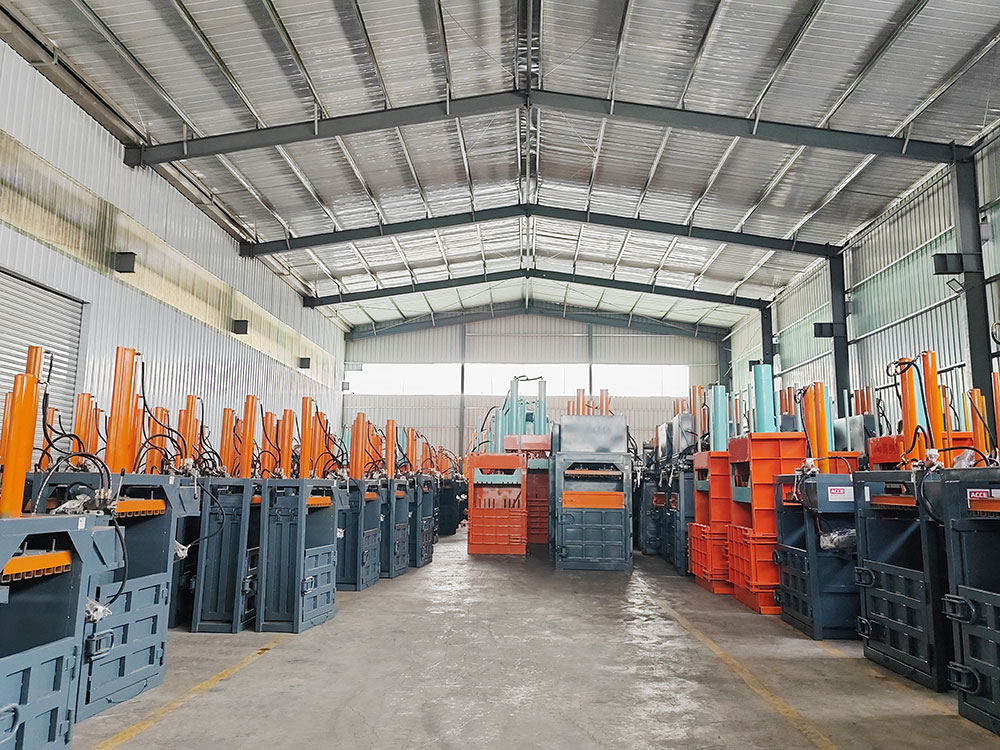
Choosing the right waste baler isn’t just a procurement decision—it’s about operational efficiency and long-term risk control. Below, I’ll guide you through the key factors to assess and the questions to ask to avoid costly mistakes.
What material are you baling?
Different materials require different feeding and compression methods. Start by analyzing your waste stream.
Every waste material—cardboard, paper, plastic film, PET bottles, textile waste, or scrap metal—behaves differently during compression.2 Identifying the primary material type affects machine configuration, feeding methods, and compression force requirements.
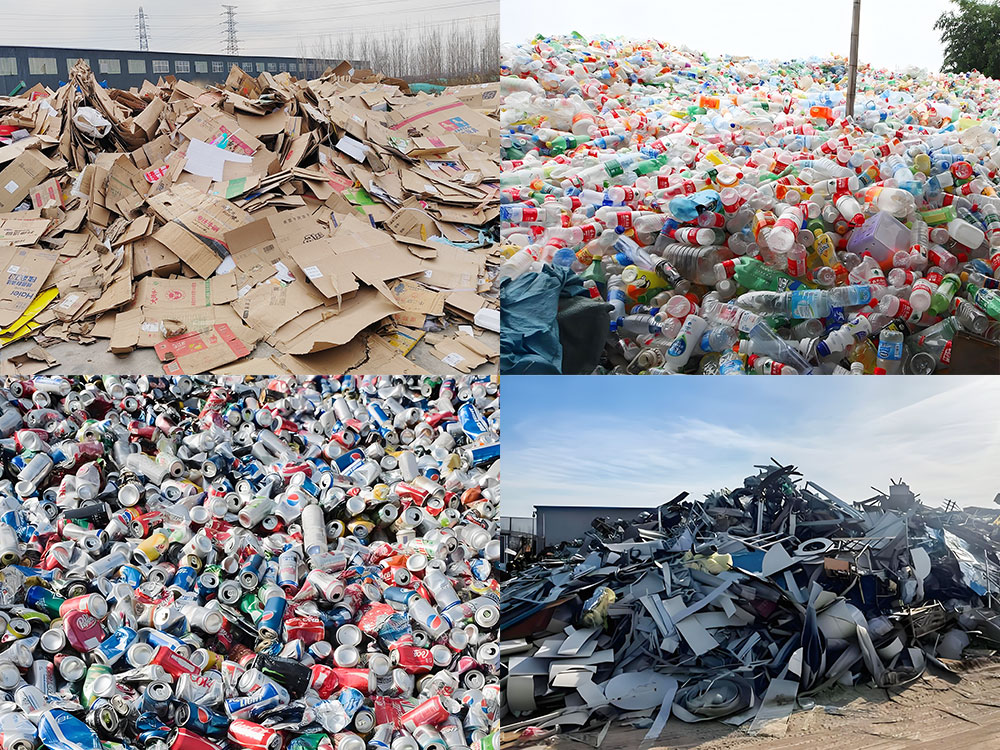
Dive deeper: Material behavior under compression
Waste baler machines are designed with specific material characteristics in mind. For example:
- Cardboard and OCC (Old Corrugated Containers): These compress uniformly and create dense, stackable bales.3 Horizontal balers with larger chamber sizes are common for high-volume plants.
- Plastic film: Requires higher compression force and tight wrapping due to its spring-back properties after baling.4
- PET bottles: Depending on size and preconditioning (caps and air removal), the baler may need customized chamber shapes or pre-crushing configurations.5
- Textile waste: Fluffy materials benefit from faster cycling times and higher throughput rather than extreme compression.6
Matching the machine to your material affects bale output and machine wear. Materials with higher density or elasticity may also demand specialized feeding systems, such as conveyors or hoppers.
How much throughput do you need?
The daily or hourly volume determines the machine size, cycle speed, and operational efficiency.
Balers are not defined purely by compression force; throughput capacity (tons per hour or day) is the real measure of scale.7 High-volume operations require machines designed for continuous processing and automation.
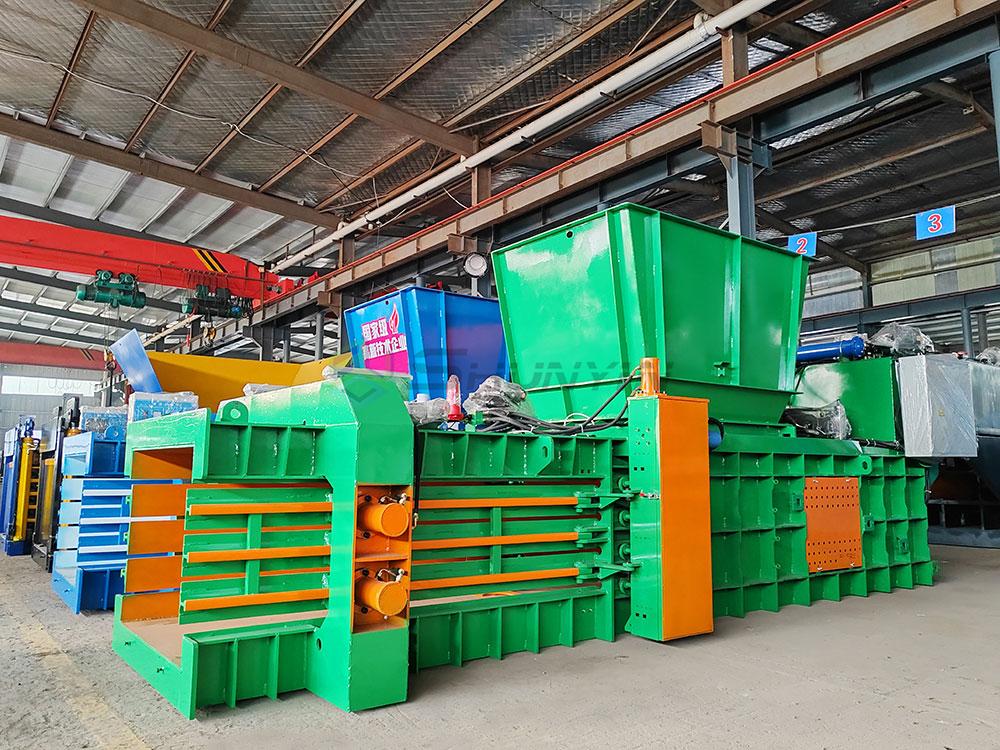
Dive deeper: Balancing throughput with machine capacity
For high-throughput facilities like material recovery facilities (MRFs):
- Horizontal balers are ideal for constant feeding and automation, handling up to 8–20 tons/hour depending on the material.
- Smaller operations with lower volumes benefit from vertical balers, which typically process 1–2 tons/day.
Other throughput considerations include:
- Cycle speed: Faster cycle times increase hourly output but may compromise bale density if compression force isn’t matched.8
- Feeding system: Conveyor belts or automatic hoppers are essential for uninterrupted operation at high volumes.
- Downtime minimization: Hydraulic and motor systems should minimize maintenance pauses and increase machine reliability.
Throughput quoted in specifications must always be conditional—ask suppliers to confirm performance under your material and operating conditions.
Why is bale density and weight critical?
The bale's density and weight determine transportation and storage efficiency—and ultimately, your cost savings per ton processed.9
A waste baler machine must create dense and stable bales that maximize transport and storage utilization without exceeding weight limitations. Bale size, density, and weight requirements are key metrics to share with your supplier.
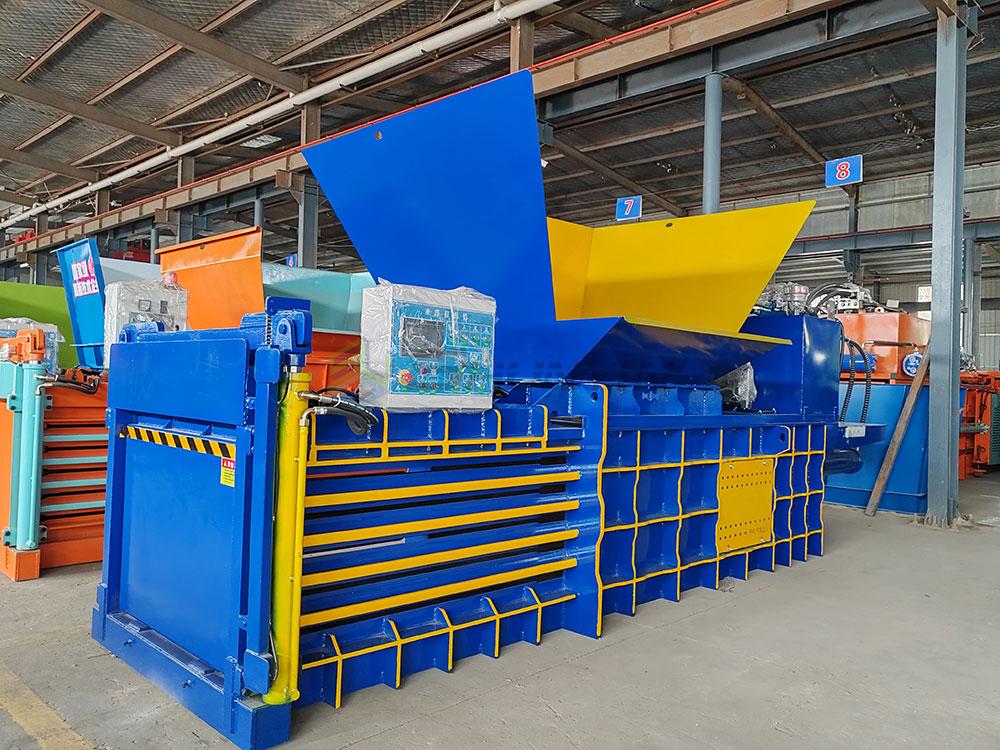
Dive deeper: Optimizing bale performance for your goals
Bale density and weight depend on several factors:
- Material compressed: Cardboard achieves higher density bales than plastic film due to its uniform compression properties.
- Compression force and chamber design: These parameters work together to create tighter bales.
- Transportation needs: Some buyers prioritize lightweight bales to avoid vehicle weight restrictions. Others prefer maximum-density bales for export containers.
Here's a quick comparison:
| Material Type | Typical Bale Size | Density Range (kg/m³) | Ideal Machine Type |
|---|---|---|---|
| Cardboard/OCC | 1200x800x800 mm | 400–600 | Medium/high-capacity horizontal baler |
| PET bottles | 1100x700x700 mm | 200–300 | High-force baler with pre-crusher |
| Plastic film | 1100x700x700 mm | 50–150 | Vertical baler with specialized chamber |
Ask whether the machine can achieve these figures consistently for your material volume and operating conditions.10
Should you avoid “universal” waste balers?
Universal waste balers often promise compatibility with all materials but may result in trade-offs in performance.
Universal waste balers may seem like a convenient choice, but they rarely deliver the best results across diverse material streams. Feeding systems, chamber configurations, and compression parameters often need customization for optimal efficiency.
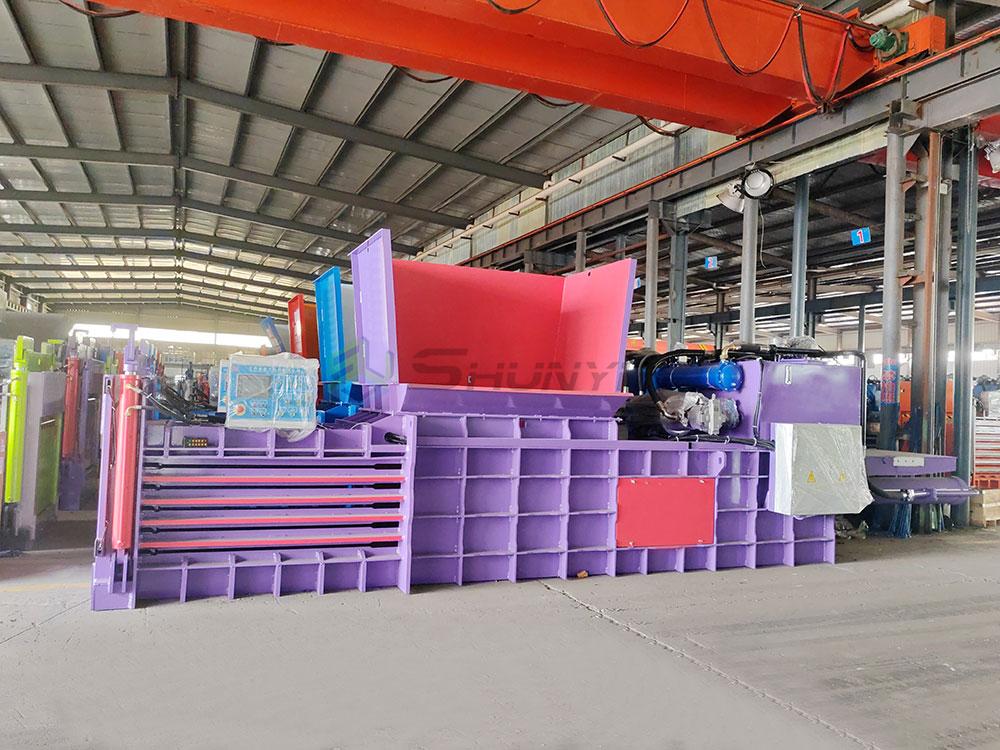
Dive deeper: Risks associated with generic models
Here’s why "universal" baler designs can create hidden risks:
- Misaligned specifications: A multi-material baler may lack the pressure, chamber size, or feeding system for specific materials like plastic film or textile waste.
- Higher wear and tear: A machine forced to process materials at the edge of its capabilities may require excessive maintenance or part replacement.
- Inefficient operation: Generic models may handle all materials but struggle to deliver consistent bale performance, particularly in specialized applications.
Instead, look for balers with modular designs or customization options. Experienced suppliers will evaluate your material composition and processing needs before recommending a design.
Frequently Asked Questions
What’s the difference between horizontal and vertical balers?
Horizontal balers are designed for higher volumes, continuous feeding, and automation, while vertical balers are compact and ideal for smaller operations.
How should I specify machine compression force?
Compression force is relevant only when paired with material type and required bale density. Ensure the supplier identifies performance under exact conditions and operating parameters.
Can a single baler process all types of materials?
Some multi-material balers can handle diverse waste types but may require configuration changes for optimal results. Specialized balers are usually more reliable for single-material operations.
Conclusion
Choosing the right waste baler machine starts with understanding your specific material, throughput needs, and desired bale performance. Avoid universal solutions that promise flexibility but deliver compromises. Instead, partner with experienced suppliers who ask diagnostic questions to minimize selection risk.
Ready to explore waste baler solutions tailored to your operation? Contact us for expert recommendations and customized support.
"Evaluation Of Solid Waste Baling and Balefills, Volume 1 ...", https://nepis.epa.gov/Exe/ZyPURL.cgi?Dockey=2000TC07.TXT. Government waste-management guidance describes balers as equipment that compacts recyclable or waste materials into bound bales, principally to facilitate handling, storage, and transportation. Evidence role: definition; source type: government. Supports: An authoritative source should define baling as the mechanical compaction of waste or recyclables into bound units that are easier to handle, store, and transport.. ↩
"Preliminary studies on recycling cardboard packaging into ...", https://pmc.ncbi.nlm.nih.gov/articles/PMC12489104/. Experimental studies of waste compaction show that compressibility and post-compaction behavior vary with material composition, initial density, geometry, elasticity, and moisture content. Evidence role: mechanism; source type: paper. Supports: Research should show that compaction behavior depends on material properties such as initial bulk density, stiffness, elasticity, geometry, and moisture content.. Scope note: Such studies may examine selected waste mixtures or individual materials rather than every material listed in the article. ↩
"Material Recovery Facilities for Municipal Solid Waste", https://nepis.epa.gov/Exe/ZyPURL.cgi?Dockey=30004DDZ.TXT. Recycling research characterizes corrugated-cardboard bales as consolidated units whose regular geometry and increased bulk density support mechanical handling and stacking. Evidence role: general_support; source type: research. Supports: A neutral recycling or materials study should document the compaction characteristics and handling stability of baled corrugated cardboard.. Scope note: Bale uniformity and stack stability also depend on moisture, contamination, binding, chamber geometry, and operator practice. ↩
"A Self-Healing Polymer with Fast Elastic Recovery upon ...", https://pmc.ncbi.nlm.nih.gov/articles/PMC7037885/. Studies of compressed polymer films document elastic recovery after load removal, supporting the need for effective restraint when film is formed into transportable bales. Evidence role: mechanism; source type: paper. Supports: Research should establish that flexible polymer films can exhibit elastic recovery after compression and therefore require restraint to retain compacted form.. Scope note: The evidence supports the spring-back mechanism but does not by itself establish a universal compression-force requirement for all film grades or baler designs. ↩
"Polyethylene Terephthalate (PET) Bottle-to-Bottle Recycling ...", https://pmc.ncbi.nlm.nih.gov/articles/PMC9231234/. Research on post-consumer PET handling indicates that intact container geometry and trapped air can impede densification, while perforation or pre-crushing can increase compaction efficiency. Evidence role: mechanism; source type: research. Supports: A recycling-engineering source should explain how intact bottle geometry and trapped air resist densification and how perforation, crushing, or other preparation changes compaction.. Scope note: This evidence supports the value of preconditioning but does not directly prove that a customized chamber is necessary in every installation. ↩
"Textile Waste: Federal Entities Should Collaborate on ...", https://www.gao.gov/products/gao-25-107165. Studies of textile-waste densification identify low initial bulk density as a major handling issue and show that compression settings must be balanced against cycle time and processing capacity. Evidence role: general_support; source type: paper. Supports: Evidence should describe the low initial bulk density of loose textile waste and the operational relationship among compression, cycle time, bale density, and throughput.. Scope note: The available evidence may support the need for balancing these variables, but not the categorical assertion that throughput should always take precedence over compression. ↩
"Badger brochure.pdf", https://icap.sustainability.illinois.edu/files/projectupdate/4825/Badger%20brochure.pdf. Engineering guidance for materials-handling systems treats throughput as a function of feed rate, cycle time, material characteristics, and equipment availability, so rated compression force alone does not determine operational capacity. Evidence role: expert_consensus; source type: education. Supports: Engineering guidance should show that equipment capacity must be assessed using feed rate, cycle time, material properties, and operating availability rather than rated compression force alone.. Scope note: Throughput is an important scale metric, but compression force remains relevant to achievable bale density and material compatibility. ↩
"Design and Experiments of a Real-Time Bale Density ... - PMC", https://pmc.ncbi.nlm.nih.gov/articles/PMC9965362/. Compaction studies show that final density depends not only on applied pressure but also on loading duration, material relaxation, and cycle conditions, creating a potential trade-off between production rate and densification. Evidence role: mechanism; source type: paper. Supports: Experimental evidence should show how compression pressure, dwell time, material relaxation, and cycle frequency affect final compacted density and production rate.. Scope note: The magnitude of this trade-off varies by material and machine control strategy; faster cycling does not necessarily reduce density when the system is properly sized. ↩
"Effect of Waste Compaction Density on Stabilization ...", https://pubmed.ncbi.nlm.nih.gov/31788730/. Waste-logistics studies find that densification can improve storage and vehicle-volume utilization and reduce the number of transport movements required for a given mass of material. Evidence role: mechanism; source type: paper. Supports: Logistics research should show that densification can increase payload per unit of storage or vehicle volume and reduce the number of handling or transport movements.. Scope note: Actual cost savings depend on whether transport is constrained by volume or legal weight, as well as distance, labor, energy use, and local operating costs. ↩
"Recycling of Plastics in the United States - PMC - NIH", https://pmc.ncbi.nlm.nih.gov/articles/PMC9004285/. Published bale-density data show substantial differences among corrugated cardboard, PET containers, and flexible plastic film, reflecting their distinct bulk densities and compaction responses. Evidence role: statistic; source type: research. Supports: Independent studies or institutional specifications should provide measured density ranges for baled OCC, PET containers, and plastic film under stated preparation and measurement conditions.. Scope note: Specific density and dimension ranges vary with moisture, contamination, container preparation, compression pressure, chamber dimensions, and whether density includes bindings or void space; contextual evidence may not validate every value in the table. ↩