

Horizontal cardboard baler cost can look deceptively simple when suppliers advertise one headline price. However, an attractive figure may hide unsuitable capacity, missing accessories, or excluded services. I recommend defining the material, daily volume, bale target, and feeding method first. Those requirements reveal the smallest reliable configuration and create a realistic budget.
A horizontal cardboard baler cost depends on processing volume, compression requirements, bale size and weight, feeding method, automation level, and quotation scope. In one confirmed Thailand case, I quoted USD 8,500 for a small horizontal hydraulic baler. That figure applied only to that configuration and should not be treated as a universal starting price.
I handle overseas baler inquiries from recycling companies, paper and packaging businesses, and equipment distributors. I have learned that the most useful price discussion begins with the job rather than the machine catalogue. The sections below explain how I turn operating requirements into a comparable purchasing budget.
What Determines Horizontal Cardboard Baler Cost?
Buyers often request a price before describing their cardboard waste stream. This sequence creates a problem because two sites may process the same material but need very different machines. I first clarify the application so that a low initial price does not lead to poor capacity or unnecessary manual work.
A horizontal cardboard baler cost is mainly determined by the required throughput, compression force, bale dimensions, target bale weight, feeding arrangement, tying system, electrical specification, and control level. I also consider the included accessories and services because the machine price alone does not show the complete procurement cost.
Material type affects more than the chamber
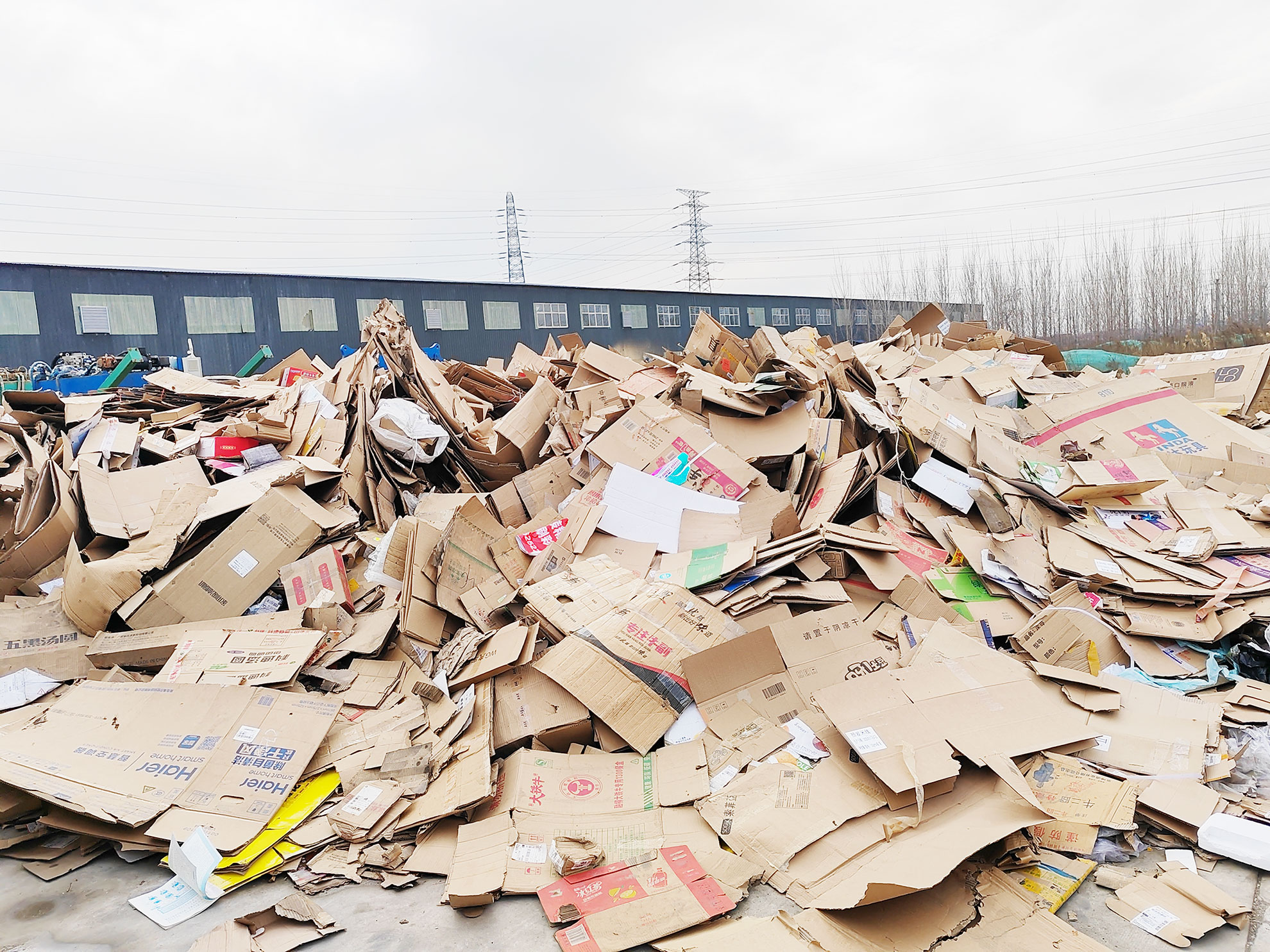
I start by asking whether the buyer processes flattened cartons, loose OCC, mixed waste paper, paper trim, or a combination of materials. OCC means old corrugated containers1, and its bulk density can vary considerably depending on how it is collected and prepared2.
Dry, flattened cardboard does not feed in exactly the same way as irregular cartons mixed with film or other packaging waste. Material condition can influence:
- Feed-opening dimensions
- Hopper design
- Conveyor requirements
- Chamber size
- Cycle consistency
- Bale-density expectations
- Need for upstream sorting or shredding
I ask buyers to share photographs or short operating videos when possible. These materials often reveal more than a short specification sheet.
Daily volume must be converted into an operating rate
A statement such as “we process ten tons per day” is helpful, but it is not complete. I also need to know the operating hours and whether the material arrives steadily or in peaks.
I use a simple planning calculation:
Required average throughput = daily material volume ÷ available baling hours
The result still needs a practical allowance for loading delays, wire changes, material variation, maintenance, and operator breaks.3 I do not recommend sizing a machine only to the theoretical average. However, I also avoid recommending excessive capacity without a clear operational reason.
Bale requirements can change the configuration
A buyer may need a particular bale size because of storage racks, truck dimensions, container loading, or downstream mill requirements. The desired bale weight and density can affect the hydraulic system, chamber design, tying arrangement, and overall machine size.
I advise buyers to confirm whether the bale target is:
- A preferred figure
- A minimum acceptance requirement
- A transport optimization target
- A downstream processor’s specification
I also explain that bale weight varies with material condition, moisture, feed consistency, and operating practice4. A catalogue value should therefore be treated as a reference rather than an unconditional result.
Feeding and automation influence both price and labor
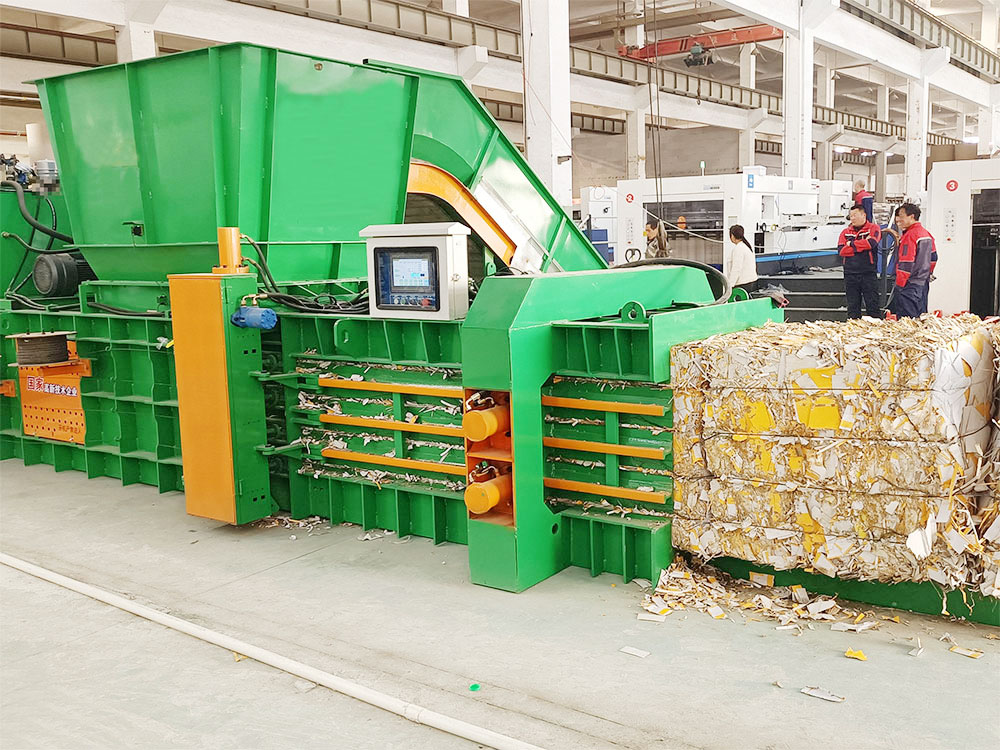
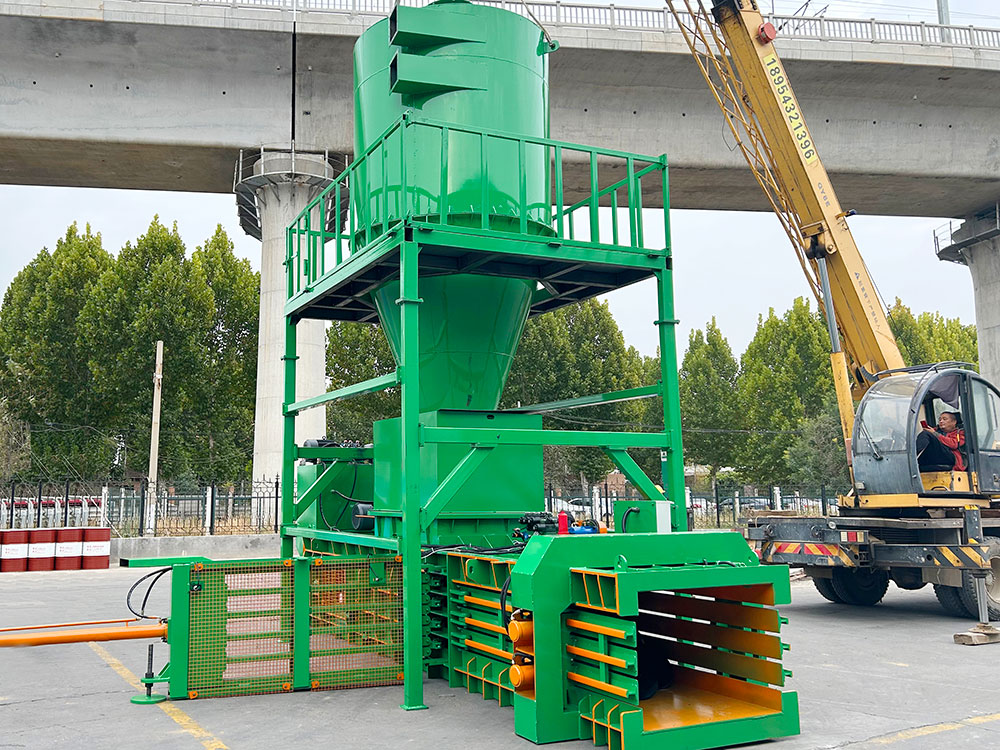
Manual loading may suit a smaller, intermittent operation. A conveyor-fed system can make more sense for continuous production or integration with a sorting line. Higher automation can increase the initial horizontal cardboard baler cost, but it may reduce repetitive handling and improve workflow.5
I compare the machine configuration with the buyer’s actual labor availability. The least expensive machine is not always the least expensive process.6
How Should I Match the Application Before Comparing Horizontal Cardboard Baler Cost?
A buyer can receive several quotations and still lack a meaningful comparison. Each supplier may assume a different capacity, bale target, or feeding method. I prevent this confusion by creating one written application brief and asking every supplier to quote against the same operating requirements.
I recommend defining at least four items before comparing horizontal cardboard baler cost: material type, daily processing volume, desired bale size or weight, and feeding method. I then add available power, installation space, working hours, labor expectations, and destination details to make the proposals more accurate.
I use an application-first inquiry checklist
I normally ask the following questions before recommending a configuration:
-
What material will the machine process?
I ask whether it is OCC, waste paper, cartons, packaging trim, or mixed recyclable material. -
How much material is generated each day?
I request a weight-based figure where possible. A count of cartons is less reliable because carton sizes vary. -
How many hours will the baler operate?
I use this answer to separate daily volume from hourly capacity. -
What bale size and weight does the buyer need?
I check transport, storage, handling, and downstream acceptance requirements. -
How will material enter the machine?
I compare manual loading, forklift loading, conveyor feeding, and connection to an existing line. -
What utilities and floor space are available?
I confirm the required voltage, frequency, phase, space, access, and foundation conditions. -
What level of automation is expected?
I discuss feeding, compression cycles, bale tying, bale discharge, and communication with other equipment.
The following table shows why these questions matter:
| Buyer information | Why I request it | Possible quotation effect |
|---|---|---|
| Material type and condition | It affects feeding and achievable compaction | Hopper, chamber, or compression configuration |
| Daily volume and operating hours | They indicate the required working rate | Hydraulic power, cycle rate, and machine size |
| Bale dimensions | They affect handling and downstream compatibility | Chamber and discharge design |
| Target bale weight | It helps define compaction expectations | Compression force and machine structure |
| Feeding method | It determines workflow and interface needs | Hopper, conveyor, controls, and guarding |
| Electrical supply | It must match the installation site | Motor and electrical component selection |
| Automation level | It affects labor and line integration | Sensors, PLC functions, tying, and discharge |
| Destination country | It affects documentation and logistics | Packing, electrical standard, freight, and compliance scope |
I distinguish minimum requirements from preferences
This distinction often prevents overspending. A buyer may prefer a heavier bale but only require a certain size for transport. Another buyer may request automatic feeding even though the baler operates for only short periods.
I divide the application brief into three groups:
- Mandatory: Requirements that the equipment must satisfy
- Preferred: Features that improve operation but can be discussed
- Optional: Accessories that can be priced separately
This structure helps me recommend the smallest configuration that can reliably perform the task. It also gives the buyer room to evaluate upgrades without losing sight of the core application.
For safety-critical sizing, line integration, structural installation, or local compliance, I recommend evaluation by qualified engineers or other competent professionals. A sales quotation should not replace an application-specific technical review.7
What Does the USD 8,500 Thailand Baler Quotation Show?
A real price example can help buyers establish context, but it can also mislead them when important boundaries disappear. I therefore present my Thailand case carefully. The quotation reflects one customer’s small-machine requirement and budget, not a market average, universal base price, or guaranteed current offer.
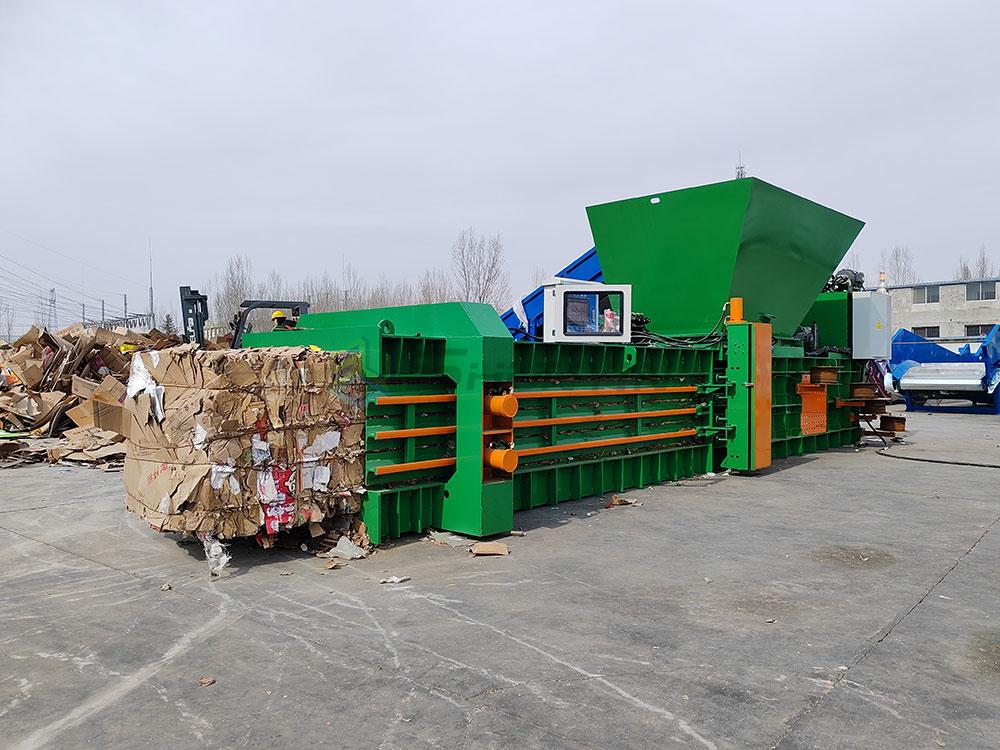
I quoted USD 8,500 for the machine in a confirmed Thailand case involving a small horizontal hydraulic baler. The configuration stayed within the customer’s budget, and the customer reports that the machine is operating well. I do not use that limited feedback to claim universal performance or long-term reliability.
The application came before the quoted price
I remember this inquiry because the customer did not need a large automated system. The practical task was to identify a small horizontal hydraulic baler that matched the requirement without exceeding the available budget.
I clarified the application and recommended a budget-compatible model. The resulting USD 8,500 machine quotation was suitable for that specific commercial discussion. I cannot responsibly transfer the figure to a different buyer without checking the new buyer’s material, throughput, bale requirements, feeding method, utilities, and required scope.
The case supports only a few careful conclusions:
- A small horizontal baler can sometimes fit a limited equipment budget.
- Application clarification can prevent unnecessary upsizing.
- A confirmed quotation can provide context when its boundaries remain clear.
- Customer feedback that a machine is “operating well” is useful but limited.
- One case does not establish a global price range or long-term performance record.
The USD 8,500 figure does not establish a market baseline
I would not describe USD 8,500 as the standard horizontal cardboard baler cost. I would also not call it a universal starting price. A different application may need more output, a larger chamber, a heavier bale, conveyor feeding, automatic tying, additional guarding, or customized controls. Any of those changes can produce a materially different quotation.
The figure also refers to the machine quotation in that case. Buyers should confirm whether their own proposals include or exclude:
- Export packaging
- Spare parts
- Feeding conveyor
- Hydraulic oil
- Installation or commissioning
- Operator training
- Inland transport
- Ocean or road freight
- Insurance
- Import duties and taxes
- Destination handling charges
- Local electrical work
- Foundations or site preparation
Freight rates, taxes, installation costs, currency effects, and regional expenses change over time.8 Every such amount requires current verification for the destination, shipping term, and purchase date.
I separate evidence from sales claims
The Thai customer’s feedback tells me that the machine is currently operating well from the customer’s perspective. It does not prove a particular service life, measured energy consumption, return on investment, or superiority over competing equipment.
I use this distinction because buyers need credible commercial evidence, not exaggerated certainty. I can share relevant experience, but I still recommend technical review, supplier verification, and written acceptance criteria before purchase.
How Can I Compare Horizontal Cardboard Baler Cost Quotations?
A low quotation can become expensive when it excludes essential equipment or assumes easier operating conditions. A higher quotation may include automation, spare parts, or commissioning that another supplier omits. I compare both technical compliance and commercial scope before I decide whether two prices are genuinely comparable.
To compare horizontal cardboard baler cost quotations, I place every proposal against one requirement sheet and one inclusion checklist. I verify the rated application, machine scope, accessories, electrical standard, documentation, delivery terms, warranty, spare parts, installation support, and acceptance process before comparing the final figures.
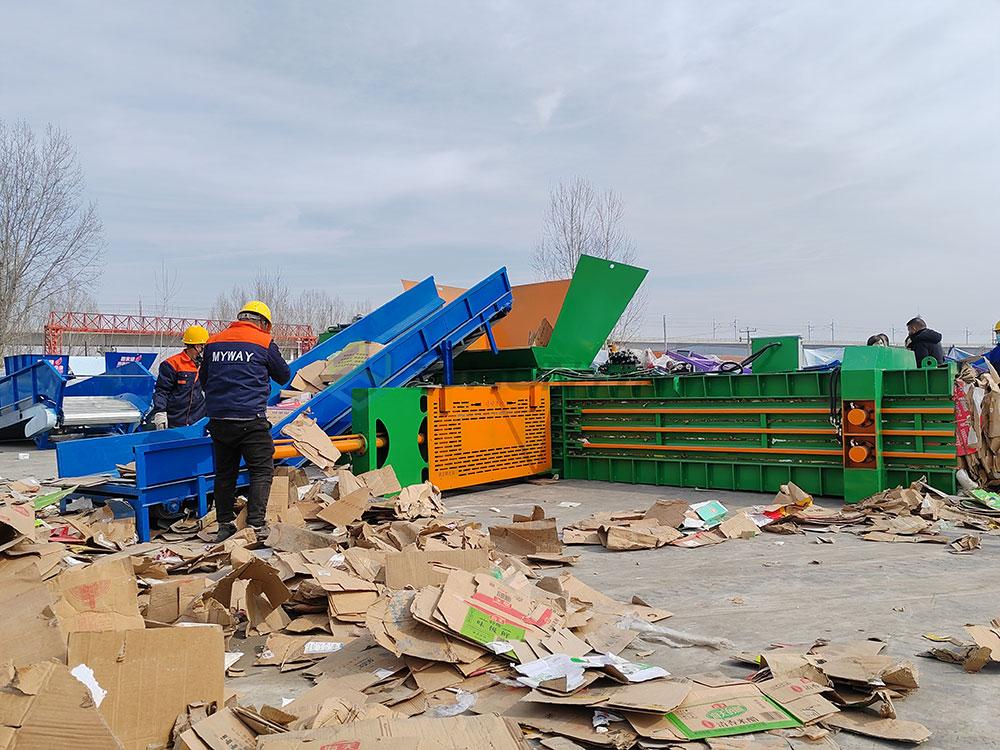
I compare three layers of cost
I separate the budget into the following levels:
| Cost layer | Typical items | Why it matters |
|---|---|---|
| Machine price | Baler, standard controls, standard accessories | It shows only the equipment offer |
| Landed project cost | Packing, freight, insurance, duties, taxes, handling | It shows the approximate acquisition budget |
| Operating cost | Labor, electricity, wire, oil, maintenance, wear parts | It influences the longer-term business case |
I do not assume that every supplier uses the same trade term. An EXW quotation and a CIF quotation cannot be compared by looking only at the total.9 Buyers should review the current Incoterms rule stated in each offer and confirm exactly where risk and cost transfer.
I normalize the technical scope
I create a comparison sheet with one row for each requirement. I then ask suppliers to mark items as included, optional, excluded, or requiring confirmation.
Important comparison points include:
- Suitable material and material condition
- Nominal and practical processing expectations
- Compression force
- Feed-opening and chamber dimensions
- Expected bale dimensions
- Bale-weight conditions
- Tying method and wire requirements
- Motor and hydraulic system configuration
- Electrical voltage, frequency, and phase
- Controls and automation functions
- Safety guards, interlocks, and emergency stops
- Conveyor or hopper scope
- Recommended spare-parts package
- Manuals and electrical diagrams
- Factory testing and acceptance documentation
- Warranty period and exclusions
- Remote and on-site support
- Manufacturing and delivery schedule
I pay special attention to capacity claims. Suppliers may calculate capacity under different material conditions. I ask what material, feed density, operator method, and cycle assumptions support the stated output.
I evaluate the supplier as well as the machine
The quotation is only one procurement document. I also review the manufacturer’s ability to build, document, deliver, and support the equipment.
I recommend asking for:
- Relevant production evidence, such as current factory photographs or a live video call.
- Reference applications involving similar materials and machine sizes.
- A written test plan that identifies what the factory acceptance test will check.
- A spare-parts list with part numbers, recommended quantities, and lead times.
- A clear warranty statement covering duration, parts, labor, shipping, and exclusions.
- Installation requirements for foundations, lifting, electrical work, and hydraulic oil.
- After-sales procedures for troubleshooting, replacement parts, and remote support.
Suppliers may provide certificates, declarations, or test reports. I treat these items as documents that buyers should verify for authenticity, issuer, model coverage, validity, and relevance to the destination market. A certificate logo on a brochure is not enough.10
For local machinery safety, electrical compliance, guarding, or line integration, I advise buyers to consult a qualified professional familiar with the destination country’s rules. I can support equipment selection and documentation, but local authorities and competent specialists determine application-specific compliance.
Frequently Asked Questions
Is USD 8,500 a typical horizontal cardboard baler cost?
No. USD 8,500 was the machine quotation for one confirmed small horizontal hydraulic baler case in Thailand. I do not present it as a typical price, market average, current offer, or universal minimum. A new quotation must reflect the buyer’s capacity, bale, feeding, electrical, and delivery requirements.
Should I choose a baler based on compression force?
I would not choose a baler based on compression force alone. Force is important, but it does not define feed handling, cycle rate, chamber size, bale dimensions, automation, or practical output.11 I recommend evaluating the complete operating task and confirming performance assumptions with the supplier.
What information should I send when requesting a quotation?
I recommend sending the material type, photographs, daily volume, operating hours, desired bale size and weight, feeding method, power supply, available space, destination port, and required automation. I also ask buyers to identify mandatory features so that I can prepare a more relevant and comparable proposal.
Does the machine quotation include freight and installation?
It depends on the supplier’s scope and Incoterms rule. I ask buyers to confirm packaging, inland transport, export handling, freight, insurance, duties, taxes, unloading, installation, training, and commissioning separately. These costs require current verification because they vary by destination, shipment date, and local service requirements.
How can I avoid buying an undersized baler?
I calculate the required operating rate from the daily volume and available baling hours. I then consider peak arrivals, downtime, loading delays, and future growth. I recommend written performance assumptions and, where practical, a witnessed factory test using representative material before shipment.
Conclusion: Planning Your Horizontal Cardboard Baler Cost
A realistic horizontal cardboard baler cost starts with the application, not a catalogue price or tonnage label. I recommend defining the material, daily throughput, bale requirements, feeding method, utilities, and quotation scope before comparing suppliers. The USD 8,500 Thailand case shows how a small, budget-compatible configuration can meet one buyer’s needs, but it does not establish a universal price. Contact us with your material photos, daily volume, bale target, power supply, and destination so we can recommend and quote a suitable configuration.
"Paper Grades and Collection | Paper Recycling | US EPA", https://archive.epa.gov/wastes/conserve/materials/paper/web/html/grade.html. Recovered-paper specifications use OCC as the abbreviation for old corrugated containers. Evidence role: definition; source type: institution. Supports: An industry or public-sector source should confirm that OCC denotes old corrugated containers in recovered-paper terminology.. ↩
"Bulk Density is an Indicator of Soil Health - SDSU Extension", https://extension.sdstate.edu/bulk-density-indicator-soil-health. Studies of recovered cardboard report that apparent density depends on material preparation and compaction state, so loose, flattened, and pre-compacted OCC need not present the same feed density. Evidence role: mechanism; source type: paper. Supports: Research should show that the apparent or bulk density of waste cardboard changes with flattening, compaction, moisture, particle form, or handling method.. Scope note: Published density measurements may apply to particular samples and preparation methods rather than every commercial OCC stream. ↩
"4. Capacity Planning and Facility Layout", https://pressbooks.usnh.edu/businessopsanalytics/chapter/capacity-planning-and-facility-layout/. Capacity-planning literature distinguishes theoretical capacity from effective capacity and accounts for setup, maintenance, delays, and worker availability when estimating sustainable output. Evidence role: general_support; source type: education. Supports: Operations-management guidance should establish that effective capacity is lower than theoretical capacity when downtime, setup, maintenance, and human factors are considered.. Scope note: General capacity-planning principles support the allowance, but they do not determine the appropriate margin for a particular baler installation. ↩
"High-pressure Compaction & Bailing Of Solid Waste", https://nepis.epa.gov/Exe/ZyPURL.cgi?Dockey=2000PVVW.TXT. Experimental work on compacted paper and cardboard shows that bale density and mass are sensitive to moisture, material characteristics, and compaction conditions. Evidence role: mechanism; source type: paper. Supports: Experimental or engineering research should show that moisture content, material composition, feed preparation, and compaction conditions influence recovered-paper bale density or weight.. Scope note: The magnitude of each effect depends on the material sample, chamber geometry, and operating procedure. ↩
"Ergonomic Guidelines for Manual Material Handling", https://www.cdc.gov/niosh/media/pdfs/Ergonomic-Guidelines-for-Manual-Material-Handling_2007-131.pdf. Ergonomic guidance identifies mechanization and automated material transfer as methods that can reduce repetitive manual handling and associated physical exposure. Evidence role: mechanism; source type: government. Supports: Occupational-safety guidance should explain that mechanizing material transfer can reduce repetitive lifting and handling exposure.. Scope note: Such guidance supports the potential ergonomic mechanism, not a guaranteed labor saving or workflow improvement for a specific baling line. ↩
"Life Cycle Cost Manual for the Federal Energy Management ...", https://nvlpubs.nist.gov/nistpubs/hb/2020/NIST.HB.135-2020.pdf. Lifecycle-cost analysis evaluates acquisition together with operating, maintenance, replacement, and related costs, so the lowest purchase price does not necessarily identify the lowest-cost alternative. Evidence role: general_support; source type: government. Supports: Lifecycle-cost guidance should establish that acquisition, operation, maintenance, replacement, and other relevant costs must be considered when comparing equipment alternatives.. Scope note: General lifecycle-cost methodology does not establish which baler configuration is least costly without application-specific cost data. ↩
"Competent Person - Overview", http://www.osha.gov/competent-person. Machinery-safety frameworks require risk assessment to consider the equipment's intended use, installation, interfaces, and foreseeable hazards rather than relying solely on commercial specifications. Evidence role: expert_consensus; source type: institution. Supports: Machinery-safety guidance should require risk assessment that considers intended use, foreseeable misuse, installation, interfaces, and site conditions.. Scope note: The responsible parties and legally required assessment procedures vary by jurisdiction and project. ↩
"Effects of Exchange Rate Volatility on Trade - IMF eLibrary", https://www.elibrary.imf.org/view/journals/024/1985/003/article-A004-en.xml. International trade data document substantial variation in freight rates and exchange rates over time, both of which can alter the delivered cost of imported machinery. Evidence role: general_support; source type: institution. Supports: International economic reporting should document that freight rates and exchange rates fluctuate over time and can affect import costs.. Scope note: Aggregate trade data do not establish the current freight, tax, installation, or currency cost for a particular destination and shipment. ↩
"Know Your Incoterms", https://www.trade.gov/know-your-incoterms. Under the Incoterms rules, EXW and CIF assign carriage, insurance, delivery obligations, and risk at different points, making their quoted totals incomparable unless the scopes are normalized. Evidence role: definition; source type: institution. Supports: An authoritative Incoterms source should explain the different seller and buyer obligations under EXW and CIF, including carriage, insurance, delivery, and risk transfer.. Scope note: Incoterms govern specified delivery obligations but do not by themselves determine title transfer, payment terms, or every charge under a sales contract. ↩
"CE marking – obtaining the certificate, EU requirements", https://europa.eu/youreurope/business/product-rules-compliance/general-product-compliance/ce-marking/index_en.htm. Official conformity guidance treats a marking as only one element of compliance and requires the relevant conformity assessment, declaration, and supporting technical documentation for the product concerned. Evidence role: general_support; source type: government. Supports: Official conformity guidance should establish that a mark must be backed by the applicable conformity procedure, declaration, technical documentation, and correct product coverage.. Scope note: The required documents and assessment bodies depend on the destination jurisdiction, product category, and applicable legislation. ↩
"High-pressure Compaction & Bailing Of Solid Waste", https://nepis.epa.gov/Exe/ZyPURL.cgi?Dockey=2000PVVW.TXT. Compaction studies indicate that pressure is only one determinant of baling performance; material properties, chamber geometry, feed conditions, and cycle parameters also affect bale density and throughput. Evidence role: mechanism; source type: paper. Supports: Compaction research should demonstrate that pressure or force interacts with material properties, chamber geometry, feed conditions, and cycle parameters to determine density and output.. Scope note: Research on particular materials or compactor designs may not provide direct performance values for the horizontal baler under consideration. ↩