

Vertical baler manufacturers are not always easy to identify through websites or online marketplaces. A supplier may look like a factory while operating as a trader, distributor, or brand owner. That uncertainty increases the risk of mismatched equipment and weak support. I recommend verifying production capability, quality control, customization, export experience, and after-sales service before buying.
Vertical baler manufacturers are companies that produce vertical hydraulic baling machines for compressing cardboard, paper, plastics, textiles, and other recyclable materials. However, buyers should not rely on a company name or product listing alone. I advise confirming that the supplier operates or directly controls production and can provide appropriate customization, documentation, spare parts, and long-term technical support.
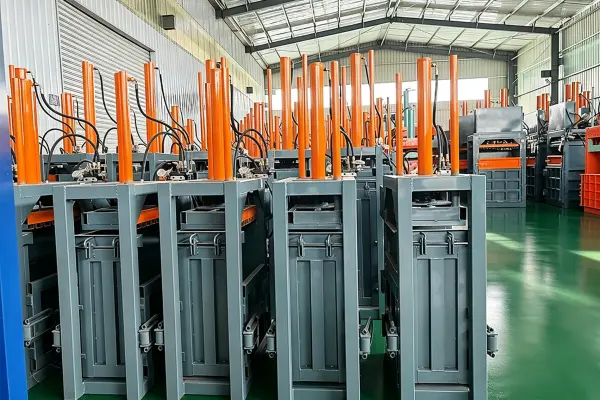
I manufacture and export recycling equipment through Jining Shunyin Machinery, and I regularly communicate with overseas buyers who face this exact challenge. From those conversations, I have learned that the better question is not simply, “Who sells vertical balers?” It is, “Which manufacturer can support my particular application and destination market?”
What Are Vertical Baler Manufacturers Responsible For?
A vertical baler may appear to be a straightforward hydraulic machine, but the supplier’s responsibilities extend beyond assembly1. Poorly defined material requirements, unclear component specifications, and limited testing can create problems after delivery. I therefore look at the complete manufacturing and support process rather than focusing only on the finished machine.
A genuine vertical baler manufacturer normally manages machine design, material selection, fabrication, hydraulic-system integration, electrical assembly, testing, and final inspection. Depending on its business model, the manufacturer may also handle customization, export packaging, operating documentation, spare-parts supply, installation guidance, and after-sales troubleshooting. Buyers should confirm which activities remain in-house and which are outsourced.
Manufacturing Is More Than Owning a Workshop
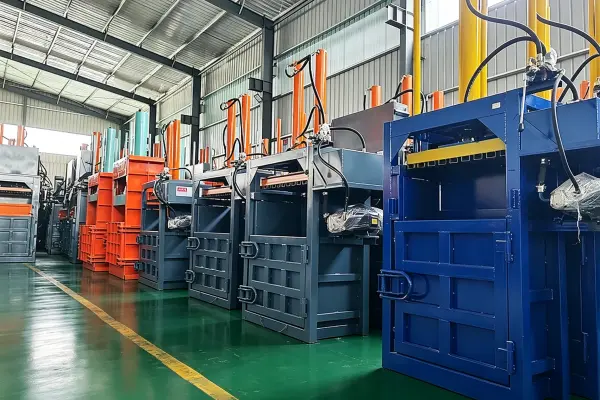
I do not treat a workshop photograph as sufficient proof of manufacturing capability. A company may have access to a production site without controlling the engineering, quality checks, or delivery schedule. I prefer to examine how the supplier moves from an inquiry to a completed machine.
A typical production scope may include:
- Application review: The supplier evaluates the material, expected throughput, feeding method, bale requirements, and operating environment.
- Model selection or customization: The supplier recommends a standard configuration or adjusts the chamber, feeding opening, controls, power system, or safety arrangement.
- Steel fabrication: The factory cuts, forms, welds, and machines structural parts.
- Hydraulic integration: The production team installs cylinders, pumps, valves, pipes, hoses, and oil tanks.
- Electrical assembly: The team integrates the motor, control cabinet, switches, sensors, and protective devices.
- Testing and inspection: The factory checks machine movement, pressure settings, controls, noise, leakage, and basic safety functions according to its documented procedure.
- Packing and dispatch: The supplier prepares the machine for inland and international transportation.
I ask buyers to confirm these steps directly because manufacturers organize production differently. Some factories fabricate the main structure but purchase hydraulic and electrical components from specialized suppliers. That arrangement is not automatically a weakness.2 The important issue is whether the manufacturer controls component specifications, incoming inspection, assembly, testing, and replacement support.
Manufacturer, Trader, Distributor, or Brand Operator?
Each supplier type can serve a legitimate purpose, but buyers should understand who is responsible for what.
| Supplier type | Typical role | Potential value | Question I recommend asking |
|---|---|---|---|
| Manufacturer | Produces and assembles the equipment | Direct production and customization access | Which processes do you perform in your factory? |
| Trading company | Sources machines from one or more factories | Broad product range and export coordination | Which factory makes this model, and can I speak with its technical team? |
| Distributor | Sells and supports equipment within a territory | Local communication, service, and parts access | Who manufactures the machine, and who handles warranty work? |
| Brand operator | Markets products under its own brand | Consistent market positioning and channel support | Does the company own production or contract it to another factory? |
At Shunyin, we have manufacturing and export activities, and we also cooperate with a Thai distributor that sells under the Shunyin brand. I present that relationship as evidence of a distributor arrangement, not as independent proof of machine performance. Buyers still need to verify the proposed machine, contractual responsibilities, and support plan for their own projects.
How Can Buyers Verify Genuine Vertical Baler Manufacturers?
Online listings make supplier discovery faster, but they also make different business models look similar.3 A polished website can create confidence without proving factory ownership or technical control. I reduce this uncertainty by requesting evidence that connects the company, production location, personnel, equipment, and quoted vertical baler.
I verify vertical baler manufacturers by reviewing business registration details, factory videos, production equipment, work-in-progress machines, quality-control records, and direct technical responses. I also request a live video inspection or third-party factory audit when project risk justifies it. No single document proves everything, so I look for consistent evidence across several sources.4
Request Current Factory Evidence
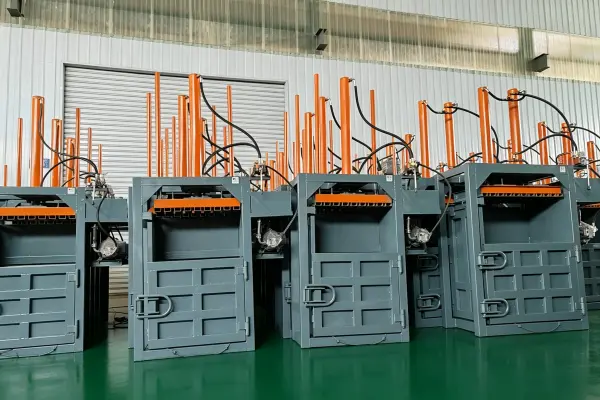
I recommend asking for current, model-specific evidence rather than relying only on promotional photographs. Useful evidence can include:
- A live video call from the production floor
- The factory entrance and company signage
- Machines at different production stages
- Cutting, welding, machining, assembly, and testing areas
- Serial-number or nameplate preparation
- Warehouse records for key components and spare parts
- Quality inspection forms with dates and responsible personnel
- Export packing examples for machines of similar dimensions
A serious supplier should normally be able to explain what the buyer sees. For example, the representative should identify whether a frame belongs to a standard vertical cardboard baler or a customized machine. The representative should also explain the next production step and identify who performs it.
I have found that direct technical conversations reveal more than generic sales presentations. When I discuss projects with buyers from Australia, Canada, Saudi Arabia, the UK, Brazil, and other markets, the most useful questions usually concern the buyer’s material and workflow. Those international contacts demonstrate the type of cross-border communication we have handled, but they do not replace project-specific verification or performance testing.
Match Documents to the Contracting Company
I ask buyers to compare the legal name on the quotation, business registration, bank account, commercial invoice, and manufacturing records. Different names can have valid explanations, such as affiliated export entities, but the supplier should explain the relationship clearly.
Buyers should investigate inconsistencies such as:
- A bank beneficiary unrelated to the quoted supplier
- Certification documents issued to another company or model
- Factory photographs that appear on several unrelated websites
- Technical drawings without revision numbers or approval records
- Test reports that do not identify the actual machine
- A salesperson who cannot arrange direct technical communication
- Different specifications appearing in the quotation and manual
I treat certificates as documents to verify, not as automatic proof that a machine complies with every requirement in the destination country.
Buyers should check the document issuer, certificate holder, model scope, standard edition, validity, and supporting reports.5 Safety and electrical requirements vary by market and application.6 I recommend using a qualified engineer, inspection body, customs adviser, or local safety professional when regulatory conformity affects machine acceptance.
How Should Vertical Baler Manufacturers Be Evaluated for Capability Fit?
Finding a real factory only solves the first problem. A genuine manufacturer may still lack the right machine, engineering process, or support structure for a particular project. If buyers focus only on price or compression force, they can receive equipment that does not match their material flow, labor availability, bale handling, or downstream requirements.
I evaluate vertical baler manufacturers by matching their proven production scope to the buyer’s material, daily volume, feeding process, desired bale size, power supply, available space, and labor plan. I also compare hydraulic configuration, structural design, control system, safety provisions, component availability, testing procedure, and customization limits before approving a model.
Begin With the Material and Operating Process
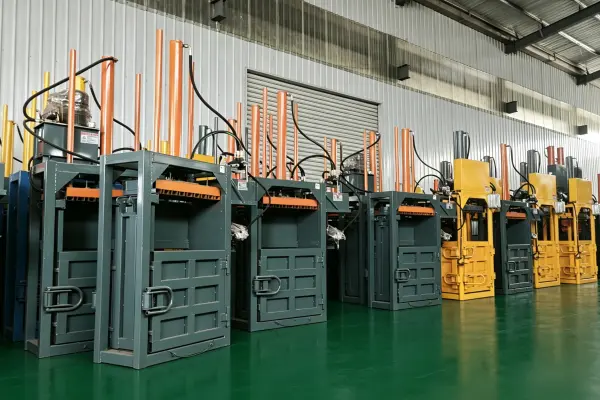
I never recommend selecting a baler from tonnage alone.7 Compression force matters, but the material’s behavior and the operating process also influence the result. Flattened cartons, loose paper, PET bottles, plastic film, textile waste, and other recyclables can feed and compress differently.
I ask buyers to prepare the following project information:
- Material type and condition: Buyers should state whether material is dry, wet, loose, flattened, contaminated, or mixed.
- Volume or weight: Buyers should provide hourly and daily quantities using measured data where possible.
- Feeding method: Buyers should identify manual loading, conveyor feeding, bin tipping, or another process.
- Required bale result: Buyers should define preferred dimensions, approximate weight range, density expectations, and tying method.
- Downstream handling: Buyers should explain forklift access, pallet use, container loading, storage limits, and recycler requirements.
- Operating schedule: Buyers should state expected shifts and working hours.
- Site conditions: Buyers should provide floor-space limits, ceiling height, door access, ambient conditions, and installation constraints.
- Utilities: Buyers should confirm voltage, frequency, phase, and site power capacity.
Bale weight and throughput can vary with material density, moisture, feeding consistency, operator practice, and machine settings.8 I therefore avoid treating brochure values as guaranteed results unless the contract defines the test material and acceptance procedure.
Compare Specifications in Context
I use a comparison table to prevent one attractive number from controlling the decision.
| Evaluation item | Why it matters | Evidence I request |
|---|---|---|
| Compression force | Influences compaction but does not alone determine bale density | Hydraulic diagram, cylinder data, and test procedure |
| Feed opening | Affects loading speed and carton preparation | Dimensioned drawing |
| Bale chamber size | Influences bale dimensions and handling | Approved technical drawing |
| Cycle controls | Affect workflow and operator involvement | Control description or demonstration video |
| Motor and power supply | Must fit local electrical infrastructure | Motor nameplate and electrical schematic |
| Tying arrangement | Influences labor and bale stability | Operating demonstration |
| Structural fabrication | Affects alignment and long-term serviceability | Welding and inspection procedures |
| [Safety system | Must suit the application and destination rules](https://www.osha.gov/laws-regs/interlinking/standards/1910.212/all)%%%FOOTNOTE_REF_9%%% | Risk documentation and component list |
| Wear and service points | Affect maintenance time | Maintenance schedule and parts drawing |
I also ask who has authority to approve customization. A salesperson may agree to a larger opening or different bale size without understanding the structural, hydraulic, or safety implications. I prefer written engineering confirmation, revised drawings, updated specifications, and clear pricing before production starts.
For application-specific decisions, buyers should involve qualified mechanical, hydraulic, electrical, and safety professionals. A manufacturer can explain its equipment, but the buyer remains responsible for confirming that the installation meets local rules and operating conditions.
What Quality Controls Should Vertical Baler Manufacturers Provide?
A machine can look complete while concealing alignment problems, leakage, undocumented component substitutions, or incomplete electrical work. Buyers who wait until arrival to inspect quality have less leverage and face higher correction costs. I therefore define inspection points before production and connect payment milestones to agreed evidence where commercially appropriate.
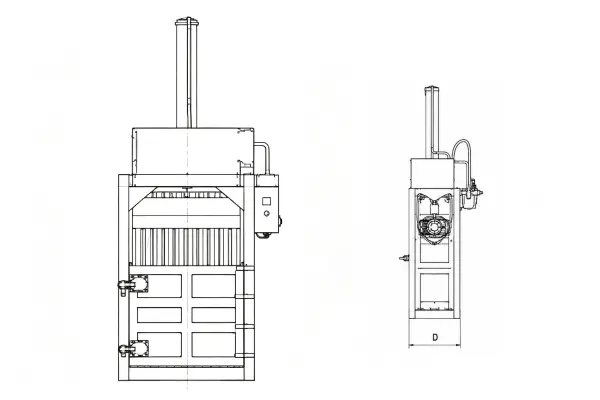
Vertical baler manufacturers should provide documented checks for incoming materials, fabrication, welding, hydraulic assembly, electrical installation, machine operation, and final packing.10 I ask suppliers to identify acceptance criteria, inspection responsibility, and record format. For higher-risk orders, I also consider pre-shipment inspection by the buyer or an independent third party.
Build a Project-Specific Inspection Plan
I prefer an inspection plan that reflects the actual order rather than a generic quality statement. The plan should identify what the factory checks, when it checks it, and how it records the result.
A practical inspection sequence may include:
- Document review: The buyer approves the final specification, drawing, component list, and electrical requirements.
- Incoming inspection: The factory checks identified steel, hydraulic components, electrical parts, and purchased assemblies.
- Fabrication inspection: The production team verifies critical dimensions, weld condition, platen alignment, and chamber assembly.
- Hydraulic inspection: The team checks pipe routing, hose protection, fittings, oil cleanliness procedures, pressure settings, and leakage.
- Electrical inspection: The team verifies wiring, labels, grounding provisions, controls, interlocks, and emergency functions.
- Operational testing: The factory cycles the machine and checks movement, controls, unusual vibration, and abnormal noise.
- Load or material testing: The parties test an agreed material when practical and define how results will be evaluated.
- Final inspection: The inspector confirms appearance, nameplate information, accessories, documents, and packing.
I recommend defining the test method before placing the order. A statement such as “the machine will be tested” is too vague. The agreement should identify the test material, number of cycles, functions checked, acceptable leakage condition, recorded settings, and evidence delivered to the buyer.
Control Component Substitutions
Supply conditions can change between quotation and production. A factory may need to replace a motor, valve, electrical device, or another component. Some substitutions can be technically acceptable, but undocumented changes create uncertainty for maintenance and spare-parts planning11.
I ask manufacturers to obtain written approval before changing specified components. I also request updated manuals, schematics, and parts lists that match the machine as shipped.
Buyers should not assume that a logo or certificate confirms complete-machine quality. They should verify whether cited documents apply to the exact model and configuration. They should also arrange professional evaluation when pressure equipment, electrical conformity, machinery safety, or workplace regulations require specialized judgment.
How Should Overseas Buyers Assess Export and After-Sales Support?
A capable factory can still become a poor overseas supplier if it handles documents, packing, parts, or communication badly. Cross-border projects create more handoffs than domestic purchases. I often see buyers focus heavily on machine price while leaving shipping responsibility, installation guidance, and warranty procedures undefined.
For overseas purchases, I assess vertical baler manufacturers on export documentation, packaging design, delivery coordination, spare-parts planning, remote support, warranty terms, and distributor capabilities. Buyers should clarify Incoterms, shipping scope, installation responsibility, response channels, and claim procedures in writing. Manufacturing ability matters, but support execution can materially change the total purchasing risk.
Define the Delivery Boundary
I ask both parties to identify the exact point at which cost and risk transfer. The quotation should use a clearly defined Incoterm and named place.12 Buyers should also confirm whether the price includes:
- Inland transport to the departure port
- Export customs handling
- Ocean freight or other international transport
- Cargo insurance
- Destination charges
- Import duties and taxes
- Unloading and movement into the facility
- Installation or commissioning
- Operator and maintenance training
Machine dimensions and weight affect transport planning, but buyers should verify final packing data before booking freight. The buyer should also confirm whether the machine can pass through site doors, fit available lifting equipment, and stand safely on the intended floor. A local structural or installation professional should evaluate foundation and site requirements when necessary.
Plan Spare Parts Before Shipment
I prefer to discuss spare parts during procurement, not after a failure. The manufacturer should identify recommended consumables, wear parts, critical electrical items, hydraulic seals, and model-specific components.
A useful parts proposal should include:
- Part name and reference number
- Installed quantity
- Recommended spare quantity
- Manufacturer or specification
- Expected sourcing route
- Price and estimated lead time
- Storage instructions where relevant
- Replacement guidance
I also check whether the manufacturer can provide remote troubleshooting through email, messaging, video calls, photographs, and machine data. The parties should identify normal response hours and escalation contacts, especially when time zones differ.
At Shunyin, our direct communication with international customers has shown me that clear questions and complete machine information make remote support more effective. However, communication history alone does not prove that every future issue will be resolved in a particular time. Buyers should rely on written warranty terms, defined procedures, parts commitments, and a realistic service plan.
Dealers should go further. They should clarify territory, branding, technical training, parts stocking, lead handling, warranty reimbursement, and end-user support. Our Thai distributor relationship illustrates one possible channel model, but every dealer should evaluate whether the commercial and service structure fits its market.
Frequently Asked Questions
Are all online vertical baler suppliers manufacturers?
No. I find that online suppliers may be manufacturers, trading companies, distributors, brand operators, or businesses combining several roles. Buyers should verify the legal entity, production address, factory processes, technical personnel, and quality records. A live factory video or independent audit can provide additional evidence.
What information should I send to a vertical baler manufacturer?
I recommend sending the material type, condition, hourly or daily quantity, preferred bale dimensions, handling method, available space, feeding process, labor plan, and power supply. Photographs and videos of the material are useful. The manufacturer can then prepare a more relevant model recommendation and quotation.
Should I choose a vertical baler based on compression force?
No. I consider compression force only one selection factor. Buyers should also examine material behavior, feed-opening size, chamber dimensions, cycle controls, bale handling, tying method, power requirements, safety provisions, and service access. Qualified professionals should review application-specific hydraulic, electrical, structural, and safety requirements.
How can I verify a vertical baler manufacturer’s certifications?
I ask for the complete documents and check the certificate holder, issuing organization, covered model, applicable standard, issue date, and supporting reports. Buyers should confirm authenticity with the issuer when appropriate. They should also use a qualified compliance professional to determine whether the documents satisfy destination-market requirements.
What should a vertical baler warranty include?
I expect a written warranty to define its duration, covered parts, exclusions, labor responsibility, shipping costs, claim evidence, response process, and available remedies. Buyers should also confirm whether local service is available or whether support is remote. A broad warranty statement without procedures provides limited practical protection.
Conclusion
Vertical baler manufacturers should be identified through verifiable production evidence, not search visibility or unsupported rankings. I recommend confirming factory control, application fit, quality procedures, customization authority, export capability, spare-parts access, and after-sales responsibilities. Buyers should also verify certificates and use qualified professionals for local safety and compliance decisions. If you are evaluating a vertical baler for cardboard, paper, plastics, textiles, or another recyclable material, contact Shunyin with your material details, required capacity, site conditions, and destination market for a project-specific equipment discussion.
"Preparing technical documentation - Your Europe", https://europa.eu/youreurope/business/product-rules-compliance/general-product-compliance/preparing-technical-documentation/index_en.htm. European machinery rules assign the manufacturer responsibility for ensuring conformity, conducting the applicable assessment, preparing technical documentation, and supplying required instructions and markings. Evidence role: definition; source type: government. Supports: Machinery rules assign manufacturers responsibilities for design, risk assessment, technical documentation, conformity assessment, and instructions, not merely assembly.. Scope note: These are European regulatory responsibilities and may differ from the legal obligations applicable in other destination markets. ↩
"Manufacturing Extension Partnership (MEP) | NIST", https://www.nist.gov/mep. ISO 9001 treats external sourcing as compatible with a quality-management system provided that the organization applies appropriate controls to externally supplied processes, products, and services. Evidence role: mechanism; source type: institution. Supports: Quality-management standards permit external sourcing while requiring the purchasing organization to define and control externally provided products, processes, and services.. Scope note: Conformity with this general principle does not demonstrate that a particular baler manufacturer exercises effective supplier control. ↩
"The role of online marketplaces in protecting and ...", https://www.oecd.org/content/dam/oecd/en/publications/reports/2022/07/the-role-of-online-marketplaces-in-protecting-and-empowering-consumers_07af735e/9d8cc586-en.pdf. OECD guidance on online marketplaces identifies seller identification and traceability as important elements of marketplace transparency and accountability. Evidence role: general_support; source type: institution. Supports: Institutional guidance recognizes that online marketplace information may not fully disclose a seller's identity, role, or relationship to the producer.. Scope note: This guidance addresses online marketplaces generally and does not establish how frequently vertical-baler sellers misstate their manufacturing role. ↩
"OECD Due Diligence Guidance for Responsible Supply ...", https://www.oecd.org/content/dam/oecd/en/publications/reports/2013/03/oecd-due-diligence-guidance-for-responsible-supply-chains-of-minerals-from-conflict-affected-and-high-risk-areas_g1g238a3/9789264185050-en.pdf. OECD due-diligence guidance describes an iterative process that draws on multiple information sources to identify and assess supply-chain risks rather than treating one document or audit as conclusive. Evidence role: expert_consensus; source type: institution. Supports: Due-diligence and auditing frameworks use document review, interviews, observation, and other evidence together because any single source may be incomplete.. Scope note: The guidance establishes a general due-diligence method, not a validation protocol specific to vertical-baler factories. ↩
"IAF: Home", https://iaf.nu/en/home/. Accreditation guidance indicates that meaningful certificate verification requires confirmation of the issuing body, certified organization, stated scope, referenced standard, and current certificate status. Evidence role: general_support; source type: institution. Supports: Accreditation and conformity-assessment guidance treats the certificate holder, scope, issuing body, referenced standard, and current status as material to certificate verification.. Scope note: The exact records required depend on whether the document is a management-system certificate, product certificate, test report, or statutory conformity document. ↩
"Machine safeguarding requirements apply to refuse ...", http://www.osha.gov/laws-regs/standardinterpretations/1985-06-05-0. European Union machinery legislation and United States workplace-safety rules use different legal frameworks, while both relate required safeguards to the machine's hazards, intended use, and operating environment. Evidence role: general_support; source type: government. Supports: Official machinery regimes impose jurisdiction-specific safety duties, while applicable safeguards depend on intended use, hazards, and installation conditions.. Scope note: This comparison demonstrates jurisdictional variation but does not identify every requirement applicable to a specific baler installation. ↩
"Design and Experiments of a Real-Time Bale Density ... - PMC", https://pmc.ncbi.nlm.nih.gov/articles/PMC9965362/. Experimental compaction studies show that bulk-material densification is governed by the interaction of applied pressure, material properties, initial density, moisture, and loading conditions, so nominal force alone does not determine the resulting bale. Evidence role: mechanism; source type: paper. Supports: Compaction research shows that resulting density and deformation depend on material properties and process conditions as well as applied pressure.. Scope note: Results from a particular material or laboratory compaction method may not directly predict the performance of every commercial vertical baler. ↩
"Moisture content of forage at baling affects ... - NDSU Agriculture", https://www.ag.ndsu.edu/news/newsreleases/2022/september/moisture-content-of-forage-at-baling-affects-forage-quality-at-feeding. Research on baling and material compaction reports that bale density and production rate vary with feedstock characteristics, moisture, loading consistency, and operating settings rather than remaining fixed machine constants. Evidence role: mechanism; source type: paper. Supports: Empirical compaction and baling studies associate output density and productivity with feedstock density, moisture, feed uniformity, and operating parameters.. Scope note: The magnitude of each effect is material- and machine-specific, so general research cannot validate a supplier's stated bale weight or throughput. ↩
"Interlinking | Occupational Safety and Health Administration", https://www.osha.gov/laws-regs/interlinking/standards/1910.212/all. Workplace-safety authorities identify balers and compactors as hazardous machinery requiring effective guarding, emergency controls, and energy-isolation procedures appropriate to the machine and its use. Evidence role: expert_consensus; source type: government. Supports: Government safety guidance identifies balers as machines requiring guarding, safe controls, isolation procedures, and safeguards matched to foreseeable hazards.. Scope note: Government workplace guidance does not by itself establish product conformity in every jurisdiction or resolve the risk assessment for a particular installation. ↩
"Model documents for the evaluation, approval, and ...", https://nvlpubs.nist.gov/nistpubs/Legacy/BSS/nbsbuildingscience87.pdf. ISO 9001 requires organizations to control externally supplied inputs and production processes, verify conformity before release, and retain documented information demonstrating that acceptance criteria were met. Evidence role: expert_consensus; source type: institution. Supports: Quality-management standards require controls over externally supplied inputs, production activities, product release, nonconforming outputs, and retained evidence of conformity.. Scope note: The standard defines a general management framework and does not prescribe the article's exact inspection sequence for vertical balers. ↩
"6.5 Configuration Management", https://www.nasa.gov/reference/6-5-configuration-management/. Configuration-management guidance requires approved changes to be identified, recorded, and reflected in the applicable technical baseline so that the as-built configuration remains traceable for operation and maintenance. Evidence role: mechanism; source type: government. Supports: Configuration-management guidance links controlled change records to accurate identification of an asset's installed components and supporting technical documentation.. Scope note: The guidance establishes the documentation mechanism but does not quantify the maintenance cost caused by an undocumented substitution in a baler. ↩
"Know Your Incoterms", https://www.trade.gov/know-your-incoterms. The International Chamber of Commerce states that Incoterms rules allocate specified delivery obligations, costs, and risks between seller and buyer and must be used with an identified named place or port. Evidence role: definition; source type: institution. Supports: Incoterms rules define specified seller and buyer obligations, cost allocation, delivery points, and transfer of risk, with operation tied to a named place or port.. Scope note: Incoterms do not determine ownership transfer, payment terms, product conformity, or every contractual obligation. ↩