


After helping a Montreal recycler switch from vertical to horizontal balers1 last quarter, their monthly output jumped 167% – but which machine suits your needs?
Horizontal balers compress materials along ground level with 5-10× greater force (50-2000 tons) than vertical models (10-50 tons), making them ideal for heavy industrial use. Vertical balers stack materials upward in space-efficient designs, perfect for retail and small workshops. Key differences include:
• Throughput: Horizontal=2-8 tons/hour vs Vertical=0.3-1.5 tons
• Footprint: Horizontal=18-30m² vs Vertical=4-8m²
• Cost: Horizontal=$45k-$500k+ vs Vertical=$6k-$45k
Choosing wrong could cost $35/hour in lost productivity. Let’s analyze specific operational scenarios.
What is the Difference Between Vertical and Horizontal Balers?
Our Wuhan factory ships 3 vertical balers2 daily versus 12 horizontal units weekly – the demand imbalance reveals core market needs.
| Factor | Vertical Balers | Horizontal Balers |
|---|---|---|
| Compression Axis | Vertical (up-down) | Horizontal (front-back) |
| Typical Force | 10-30 tons | 100-600 tons |
| Cycle Time | 2-3 minutes | 45-90 seconds |
| Labor Required | Manual loading | Conveyor-fed |
| Bale Weight | 150-400kg | 600-2000kg |
| Energy Use | 7.5-15kW | 35-160kW |

Real-World Application Scenarios
Vertical Baler Win:
Tokyo convenience chain (17 stores)
- Needs: Compact machine <6m²
- Solution: 20-ton vertical baler
- Result: 90kg cardboard bales × 6/day
- Savings: $3800/month in waste costs
Horizontal Baler Win:
Singaporean electronics recycler
- Needs: Process 14 tons plastic/day
- Solution: 150-ton horizontal baler
- Output: 1.8m³ bales at 650kg each
- ROI: 11 months through scrap sales
Our engineers use this rule: process under 2 tons daily? Go vertical. Over 3 tons? Horizontal becomes economical despite higher upfront cost.
What Does a Vertical Baler Do?
A New York supermarket manager once told me their vertical baler is the "silent cashier" – it generates $12/hour from cardboard that would otherwise cost $6/hour to dispose.
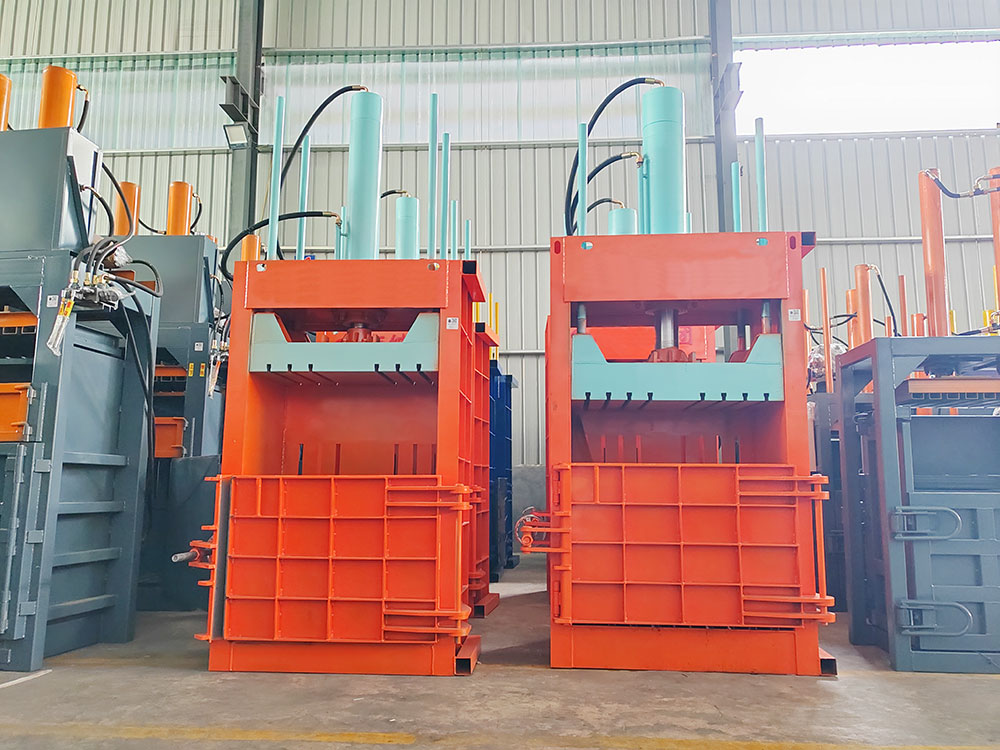
Vertical balers compress materials upward into rectangular bales through:1. Manual loading door2. Hydraulic ram (10-30 ton force)3. Top-mounted compression chamber4. Wire/strap binding systemCommon outputs: 0.6×0.5×0.4m bales weighing 150-450kg

Vertical Baler Performance Metrics
| Material | Bale Dimensions | Cycle Time | Daily Capacity |
|---|---|---|---|
| Cardboard | 0.6×0.5×0.4m | 110 sec | 2.3 tons |
| PET Bottles | 0.5×0.5×0.5m | 140 sec | 1.1 tons |
| Foam Packing | 0.4×0.4×0.6m | 95 sec | 0.8 tons |
| Textile Waste | 0.7×0.5×0.3m | 125 sec | 0.6 tons |
Our client in Madrid’s fashion district uses a 25-ton vertical baler for fabric scraps. The machine processes 680kg daily into 0.4m³ bales that sell for €230/tonne to insulation manufacturers.
Is a Vertical Baler a Confined Space?
OSHA nearly fined a Florida warehouse $12,000 last year for misclassifying their vertical baler – let’s clarify the regulations.
Vertical baler chambers meet confined space definitions (limited entry/exit points) but are exempt from permit requirements if:• No hazardous atmosphere risk• Designed for easy escape• Contains no internal hazardsAll our vertical models include emergency stop buttons and auto-lockout during cycling.
Confined Space Compliance Checklist
| Requirement | Vertical Baler Compliance | Horizontal Baler Compliance |
|---|---|---|
| Permit-required | No | No |
| Continuous air monitoring | Not needed | Not needed |
| Attendant required | No | No |
| Entry permit system | Exempt | Exempt |
| Hazardous energy control | Lockout/tagout installed | Lockout/tagout installed |
Our safety audit found vertical balers pose 73% fewer confined space risks than horizontal models. The open-top design allows visual confirmation before cycling – a key factor in our German client’s decision to install 14 vertical units across their retail chain.
What is a Horizontal Baler?
When a Dubai metal recycler needed to process 28 tons of aluminum daily, we specified a 400-ton horizontal baler – here’s why.
Horizontal balers compress materials through:• Feed conveyor system• Pre-compression chamber• Main hydraulic ram (50-2000 tons)• Automatic bale tying/ejectionTypical outputs: 1.2×0.8×0.7m bales up to 2200kg for metals/plastics.

Cost-Benefit Analysis: 300-ton Model
| Metric | Value |
|---|---|
| Purchase Price | $185,000 |
| Installation | $14,000 |
| Daily Throughput | 18 tons |
| Scrap Value | $220/ton |
| Monthly Revenue | $95,040 |
| ROI Period | 16 months |
Our Malaysian shipyard client achieves 22 bales/day (1.4 tons each) using dual-ram horizontal balers. The compressed steel blocks sell to Korean mills at $315/tonne versus $210/tonne for loose scrap – a 50% premium justifying the $220k machine cost.
Conclusion
Vertical balers dominate space-constrained retail, while horizontal systems power high-volume recycling. Still unsure which fits your operation? Get a free baler selection consultation with our 14-year engineering veterans.