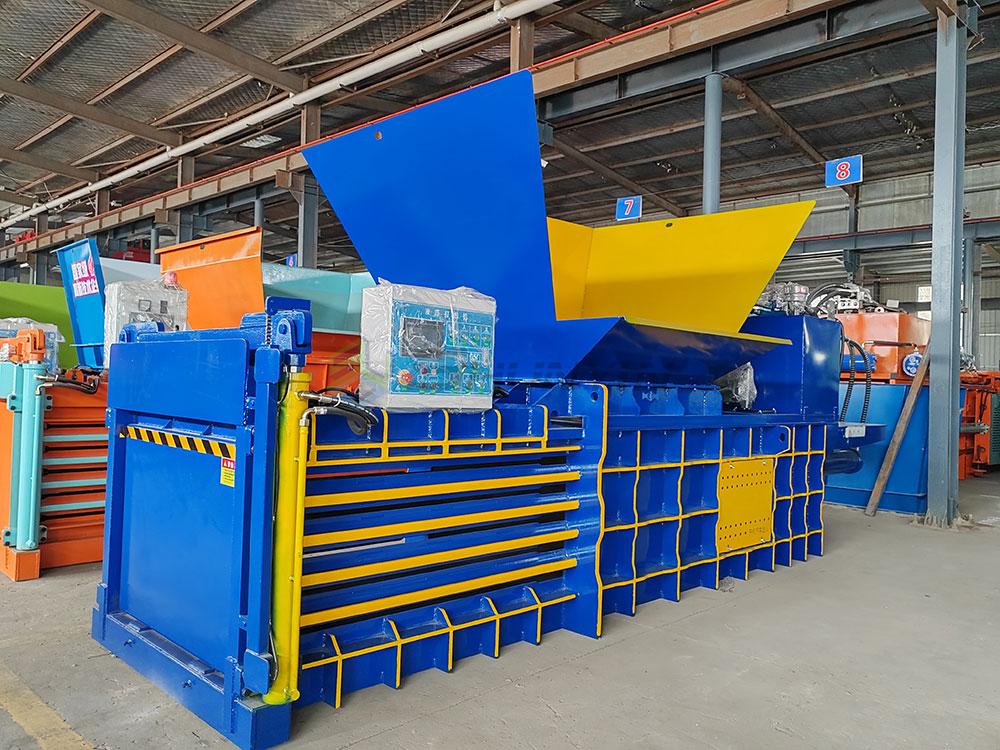

What are the different types of balers?
Choosing the right baler can feel overwhelming, especially when considering the many types available. The primary keyword, types of balers, represents more than a surface-level list of machines; it’s a classification system that spans structure, material compatibility, automation level, and operating methods. Clarifying these dimensions is key to selecting the right baler for your specific task.
There are four main ways to classify balers: by structure (vertical vs. horizontal), material compatibility (e.g., cardboard, plastic, or metal), drive system (hydraulic vs. manual), and automation level (semi-automatic vs. fully automatic).1 Buyers must first assess their operating requirements—material type, bale dimensions, throughput—before matching a machine to these categories.2
Understanding how balers differ is vital for avoiding costly mistakes, like oversizing the wrong structure or ordering based on a familiar machine name. Let’s break down each classification type to clarify how these machines are grouped—and how they should be selected for real-world applications.
How are balers classified?
Balers are not just grouped under one single category. Instead, their classification depends on factors like structure, material compatibility, automation, and operating methods.
Balers are typically classified into categories based on their structure (vertical or horizontal), the materials they’re designed to process, and their automation level. For instance, a horizontal baler might process cardboard while offering fully automatic operation, but that same machine won’t suit scrap metal. Buyers need to align categories with their recycling needs.
To select the right baler, start from your operational requirements:
- Material type: Is it metal, cardboard, plastic, or textiles?
- Bale specifications: What’s the required bale size, weight, and density?
- Process throughput: How many tons per day must the machine handle?
- Feeding and storage: Should bales integrate into storage or transport workflows?
Balers often span multiple categories. For example, a "horizontal cardboard baler" is both horizontally structured and material-specific. Let’s explore these classification dimensions in detail.
What are vertical and horizontal balers?
When it comes to baler structure, machines are categorized as either vertical or horizontal based on layout.
Vertical balers compress material downwards in a stationary chamber, while horizontal balers process material along a conveyor or hopper system for more efficient feeding.3 Vertical models suit low-throughput operations, whereas horizontals excel in high-volume recycling environments.4
Vertical balers are compact, making them ideal for warehouses or small facilities processing less material.5 They’re commonly used for cardboard, paper, or textile waste, where large-scale automation isn’t essential.
Horizontal balers, however, feature conveyor-fed or hopper-fed systems equipped for higher throughput.6 Their versatility is unmatched in environments like recycling plants, material recovery facilities (MRFs), or manufacturers managing mixed waste streams.
Key differences at a glance:
| Feature | Vertical Baler | Horizontal Baler |
|---|---|---|
| Capacity | Lower throughput | High throughput |
| Footprint | Compact design | Large space needed |
| Automation level | Manual or semi-automatic | Semi or fully automatic |
| Applications | Small-scale recycling | Industrial-scale needs |
Selecting between vertical and horizontal comes down to resolving operational demands: space constraints, processing volume, and automation preferences.
How does material compatibility shape baler selection?
A baler’s ability to process different materials is another core classification criterion.
Cardboard balers, plastic balers, textile balers, and scrap metal balers are designed with operating parameters suited to those materials, such as press force, chamber configuration, and feeding methods.7 Misaligning material type and baler design can result in poor compression efficiency or equipment damage.8
For example, cardboard and paper require moderate press force, while textiles demand specialized handling to prevent overflow or machine damage. Plastics vary based on form—PET bottles, rigid plastics, or stretch film might need specific chamber sizes.9 Scrap metal balers require the highest compression force, aligning performance with hardened safety systems.
Material-specific considerations:
- Cardboard/Paper: Moderate force. Prioritize bale size uniformity.
- Textiles: Flexibility in feeding and handling. Medium compression settings recommended.
- Plastics: Adjustable chambers depending on bottle, film, or rigid forms.
- Scrap metal: Maximum press force. Reinforced durability and metal integration.
Customization plays a big role—always confirm material testing data, especially for mixed recycling scenarios.
What are semi-automatic and fully automatic balers?
Automation refers to how much human intervention is required during operation.
Semi-automatic balers require manual feeding and bale tying, whereas fully automatic balers complete feeding, compressing, and tying with minimal oversight.10 Automation levels should align with labor availability and throughput demands, ensuring productivity without prohibitive costs.
Automation decision factors:
| Automation Level | Use Cases | Drawbacks |
|---|---|---|
| Semi-automatic | Small teams, limited materials | High labor demand |
| Fully automatic | Large operations, uniform throughput | Higher capital investment |
Be sure to weigh labor implications heavily. For instance, many packaging plants or manufacturers benefit from upgrading to fully automatic solutions as they streamline workflows and reduce long-term operational costs.11
What are the risks of misclassifying balers?
When buyers don’t match the right baler to their task, they risk wasted capital and inefficient operation.
Misclassifying balers can lead to oversizing equipment or choosing a machine incapable of processing your target material correctly. Avoid product-name decisions like choosing a “vertical baler” that seems familiar or oversizing for weight while neglecting proper structural fit.
One specific example: I once worked with a Saudi recycling customer who needed a machine for light scrap metal. Initially, they preferred a vertical hydraulic baler based on familiarity, but after calculating requirements for block density and typical metal handling loads, we recommended a dedicated metal baler instead. This choice cut costs by 22% while enabling easier downstream handling.
Frequently Asked Questions
What materials can a baler handle?
Most balers handle recyclable materials like cardboard, plastics, textiles, and scrap metal. Material specification matters—unique adjustments ensure compression efficiency and machine durability.
What’s the difference between vertical and horizontal balers?
Vertical balers compress material in a smaller, stationary chamber and suit light materials. Horizontal balers integrate automated feeding systems, designed for large-scale operations.
Should I pick semi-automatic or fully automatic balers?
Pick automation level based on your throughput and labor model. Fully automatic balers offer hands-free operation; semi-auto models save upfront cost but need manual input.
What’s the best baler for mixed recycling?
For mixed recycling, opt for versatile horizontal balers that provide adjustable chamber and feeding systems to accommodate varied materials.
Conclusion
Balers are classified across structure, material compatibility, automation level, and operating method—but the types of balers themselves aren’t standalone labels. Matching these types to your recycling task means carefully assessing materials, bale specifications, and throughput. Remember the takeaway: start by identifying operational demands, and then choose a machine adapted for efficiency and cost-effectiveness. Ready to clarify your recycling needs? Contact us today for expert advice!
"(PDF) The Design and Fabrication of a Horizontal Hand Baler", https://www.academia.edu/65946065/The_Design_and_Fabrication_of_a_Horizontal_Hand_Baler. Technical descriptions of baling equipment commonly distinguish machines by press orientation, intended feed material, actuation system, and level of automated feeding or tying. Evidence role: definition; source type: education. Supports: Technical guidance should confirm that balers are commonly distinguished by orientation, material application, power or drive system, and degree of automation.. Scope note: Terminology and classification schemes vary across agricultural, packaging, and waste-management contexts, so a source may support the dimensions without prescribing exactly four universal categories. ↩
"Material Recovery Facilities for Municipal Solid Waste", https://nepis.epa.gov/Exe/ZyPURL.cgi?Dockey=30004DDZ.TXT. Guidance on materials-recovery equipment identifies feedstock characteristics, required bale specifications, and anticipated processing rate as important inputs when sizing and configuring a baler. Evidence role: general_support; source type: institution. Supports: Waste-processing guidance should identify feedstock characteristics, desired bale specifications, and processing rate as relevant baler-selection inputs.. Scope note: These factors are central but not exhaustive; site layout, electrical capacity, safety requirements, maintenance access, and downstream buyer specifications may also affect selection. ↩
"SHIB 08-13-2013 - Operating Hazards of Baler Discharge-Door Locks", http://www.osha.gov/publications/shib081313. Equipment-safety guidance describes vertical balers as machines that compact material through a downward-moving platen, while horizontal balers use a horizontal ram and are often supplied through a hopper or conveyor. Evidence role: mechanism; source type: government. Supports: An occupational-safety or engineering source should describe the direction of compression and typical feeding arrangements of vertical and horizontal balers.. Scope note: Not every horizontal baler includes a conveyor, and feeding arrangements differ by installation. ↩
"Massachusetts Temporary Laborer is Crushed in Baler at Recycling ...", https://stacks.cdc.gov/view/cdc/166621. Materials-recovery guidance generally associates vertical balers with intermittent, lower-volume generation and conveyor-fed horizontal balers with continuous or higher-volume processing. Evidence role: general_support; source type: research. Supports: Research or institutional guidance should show the typical relationship between baler orientation, feeding mode, and processing volume.. Scope note: Orientation alone does not determine capacity; ram force, chamber dimensions, cycle time, feed consistency, and staffing can produce overlapping throughput ranges. ↩
"Green Job Hazards - Recycling: Cardboard Baling", http://www.osha.gov/green-jobs/recycling/cardboard-baling. Facility guidance characterizes vertical downstroke balers as comparatively compact units commonly installed where recyclable volumes and available floor space are limited. Evidence role: general_support; source type: institution. Supports: Facility-planning guidance should document the relatively compact installation and common small-site use of vertical balers.. Scope note: Suitability still depends on clearance, loading access, bale removal space, electrical service, and applicable safety zones rather than footprint alone. ↩
"Design and Fabrication of a Simplified Mechanical Handling System ...", https://www.academia.edu/68427813/Design_and_Fabrication_of_a_Simplified_Mechanical_Handling_System_of_Rice_Straw_Baling_Operation_to_Reduce. Studies of materials-recovery systems describe conveyors and feed hoppers as means of supplying a more continuous stream of material to horizontal balers, thereby supporting higher system throughput than intermittent manual loading. Evidence role: mechanism; source type: paper. Supports: Engineering or materials-recovery research should explain that hopper or conveyor feeding can provide a more continuous material flow and reduce interruptions between compaction cycles.. Scope note: A conveyor does not by itself guarantee higher throughput, which remains constrained by baler cycle time, feed density, sorting performance, and downstream handling. ↩
"Resistance to Compaction/Baling of Recyclable Cardboard Waste ...", https://www.academia.edu/123234311/Resistance_to_Compaction_Baling_of_Recyclable_Cardboard_Waste_Using_Stationary_Horizontal_Presses. Compaction research shows that feedstock properties—including bulk density, compressibility, elasticity, and particle or item geometry—affect the pressure, confinement, and feeding conditions required to form stable bales. Evidence role: mechanism; source type: paper. Supports: Research should show that material properties such as compressibility, elasticity, bulk density, and geometry influence required pressure, chamber design, and feeding behavior.. Scope note: General compaction principles support material-specific design, but they do not establish a single prescribed configuration for every cardboard, plastic, textile, or metal stream. ↩
"1926.403 - General requirements.", http://www.osha.gov/laws-regs/regulations/standardnumber/1926/1926.403. Baler safety guidance instructs operators to process only materials permitted for the machine, because unsuitable or irregular feed can cause blockages, ineffective compaction, unsafe ejection, or mechanical damage. Evidence role: general_support; source type: government. Supports: Safety guidance should establish that balers must be operated only with intended materials and that unsuitable feed can cause jams, unsafe conditions, or mechanical damage.. Scope note: The likelihood and type of damage depend on the machine design, the material introduced, and compliance with operating procedures. ↩
"Domestic Mixed Plastics Packaging Waste Management Options", https://www.academia.edu/5023812/Domestic_Mixed_Plastics_Packaging_Waste_Management_Options. Research on plastic-waste densification reports that bottles, rigid articles, and flexible films differ in bulk density, deformation, and elastic recovery, factors that can require different feeding, confinement, or chamber arrangements. Evidence role: mechanism; source type: paper. Supports: Research should demonstrate that plastic form and material behavior influence bulk density, rebound, feeding, and containment during compaction.. Scope note: Such evidence supports configuration differences generally but may not identify chamber size as the decisive parameter for every plastic stream. ↩
"[PDF] Manual Pine Straw Baler", https://training.jacksonms.gov/uploaded-files/vJW49K/6OK125/manual__pine-straw__baler.pdf. Technical descriptions distinguish baler automation levels by the operator involvement required in loading, initiating compaction cycles, tying, and discharging completed bales; fully automated lines typically automate more of these functions. Evidence role: definition; source type: education. Supports: A technical source should distinguish automation levels according to which feeding, cycling, tying, and discharge tasks require operator intervention.. Scope note: The labels “semi-automatic” and “fully automatic” are not perfectly standardized, and some systems automate tying and cycling but not material feeding. ↩
"[PDF] Design of a Materials Recovery Facility (MRF) For Processing the ...", https://www.columbia.edu/cu/seas/earth/wtert/newwtert/Research/sofos/dubanowitz_thesis.pdf. Research on waste-processing automation indicates that automated material handling and bale tying can reduce repetitive manual tasks and labor time, potentially lowering unit operating costs where throughput is high and sufficiently consistent. Evidence role: general_support; source type: research. Supports: A productivity or lifecycle-cost study should show that automated feeding and tying can reduce manual handling and labor time under sufficiently high and consistent throughput.. Scope note: This is a conditional economic effect rather than direct proof of savings for all packaging plants; capital cost, maintenance, utilization, energy use, downtime, and local labor rates determine the actual payback. ↩