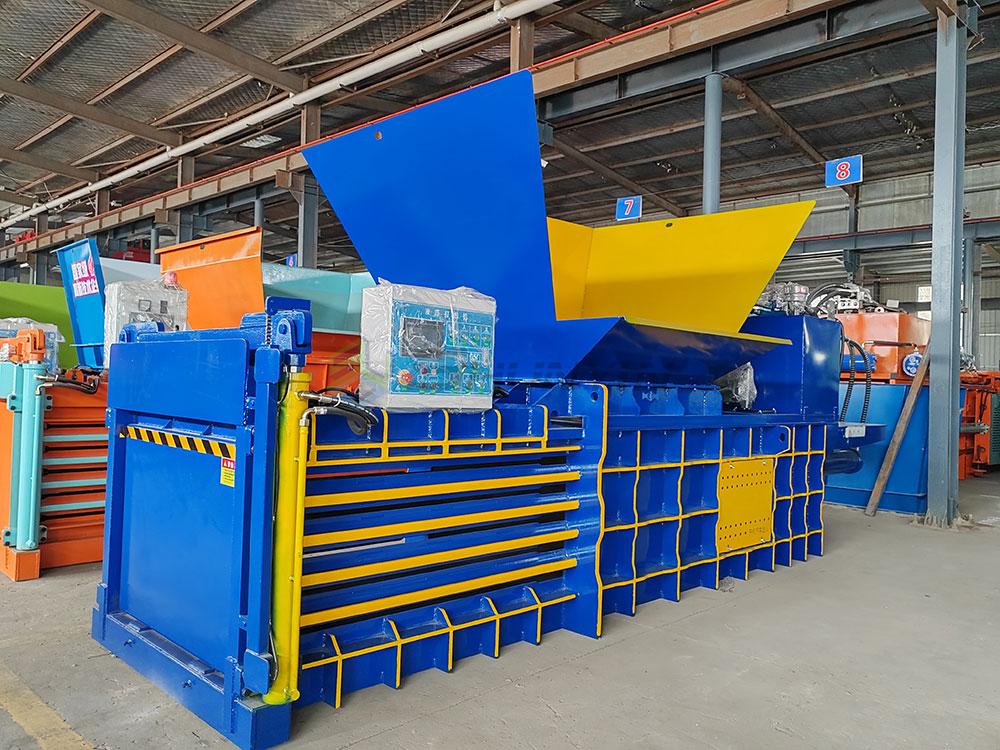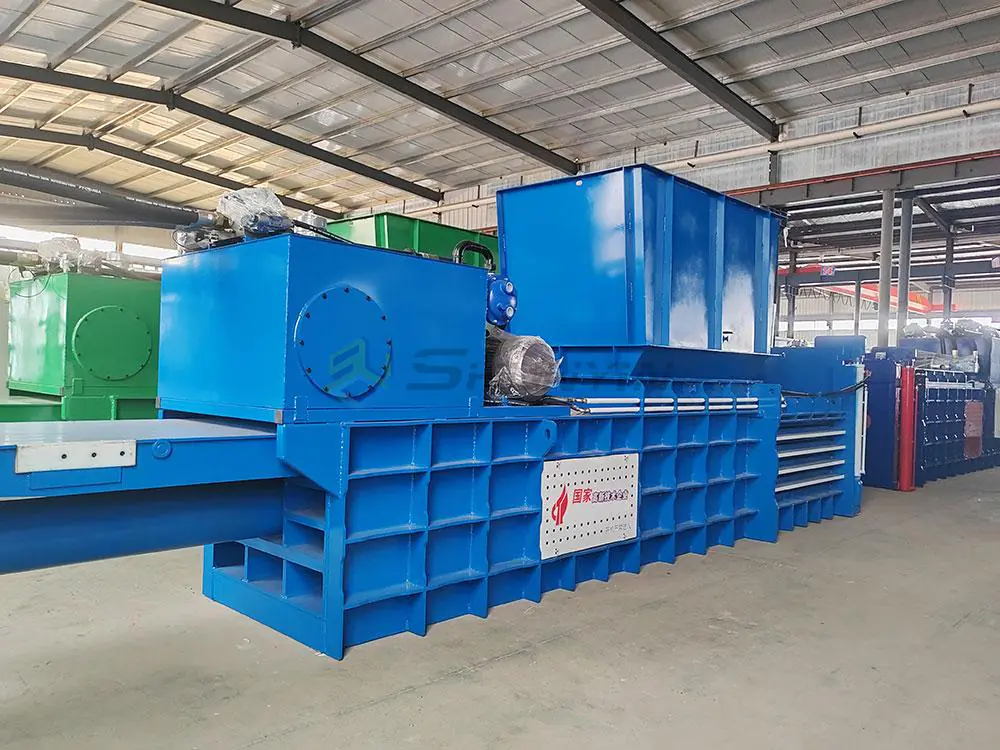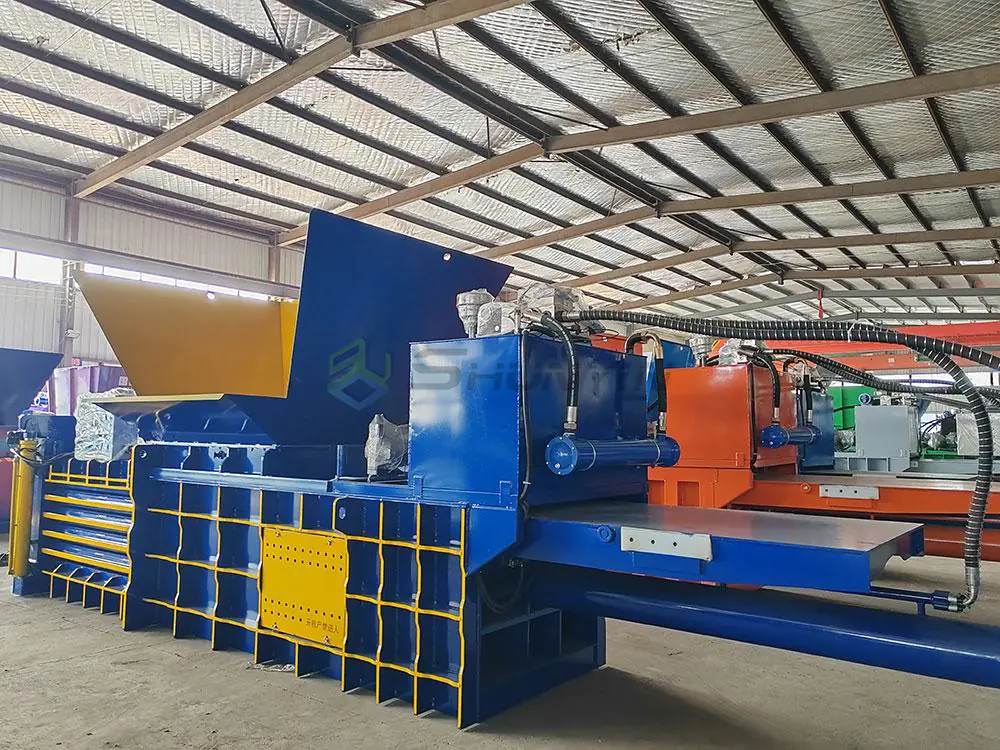

Tire balers compress tires into dense, transport-ready bales for recycling or disposal. This hydraulic process involves loading tires, compressing them, restraining or tying the bale, and removing it for storage or transportation. However, selecting the right baler requires more than understanding basic operation—buyers must account for tire type, size, rim presence, and downstream demands.
A tire baler works by compressing tires into transportable, dense bales through a hydraulic system. The process involves loading tires into the baler chamber, applying force to compress them, restraining or tying the bale securely, and ejecting it from the machine. Matching bale specifications to tire and throughput needs ensures efficient operation.
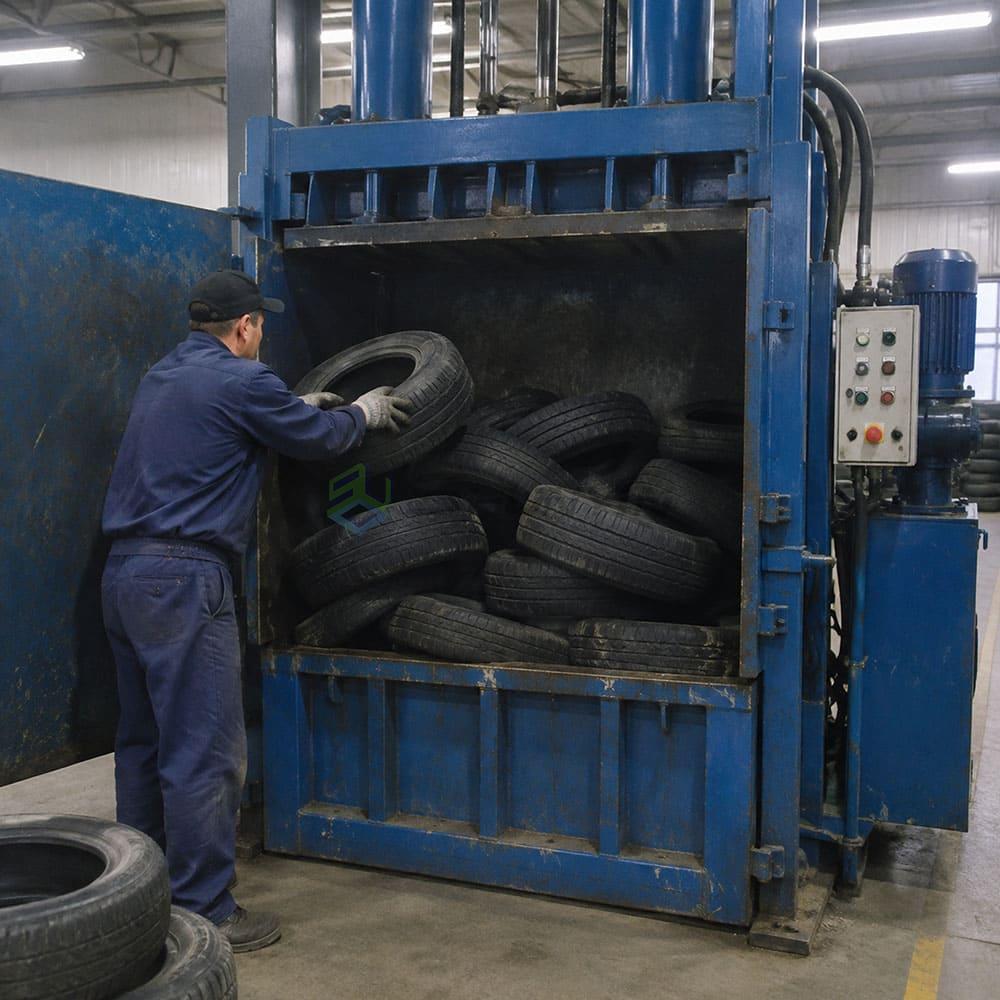
The mechanics might seem straightforward, but baler selection and usage hinge on critical requirements like tire type, bale dimensions, and throughput volume. Let’s explore the complete cycle and its implications to help you make the right equipment decision.
What is the operating cycle of a tire baler?
A tire baler’s operating cycle follows four primary steps: loading tires, compressing them, restraining or tying the compressed material, and ejecting the bale.1 Each step directly impacts the machine’s suitability for specific applications.
The operating cycle includes loading tires into the chamber, compressing them hydraulically into dense bales, tying or restraining the compressed material, and ejecting the finished bale. Selecting the right machine depends on tire size, rim presence, and bale requirements.
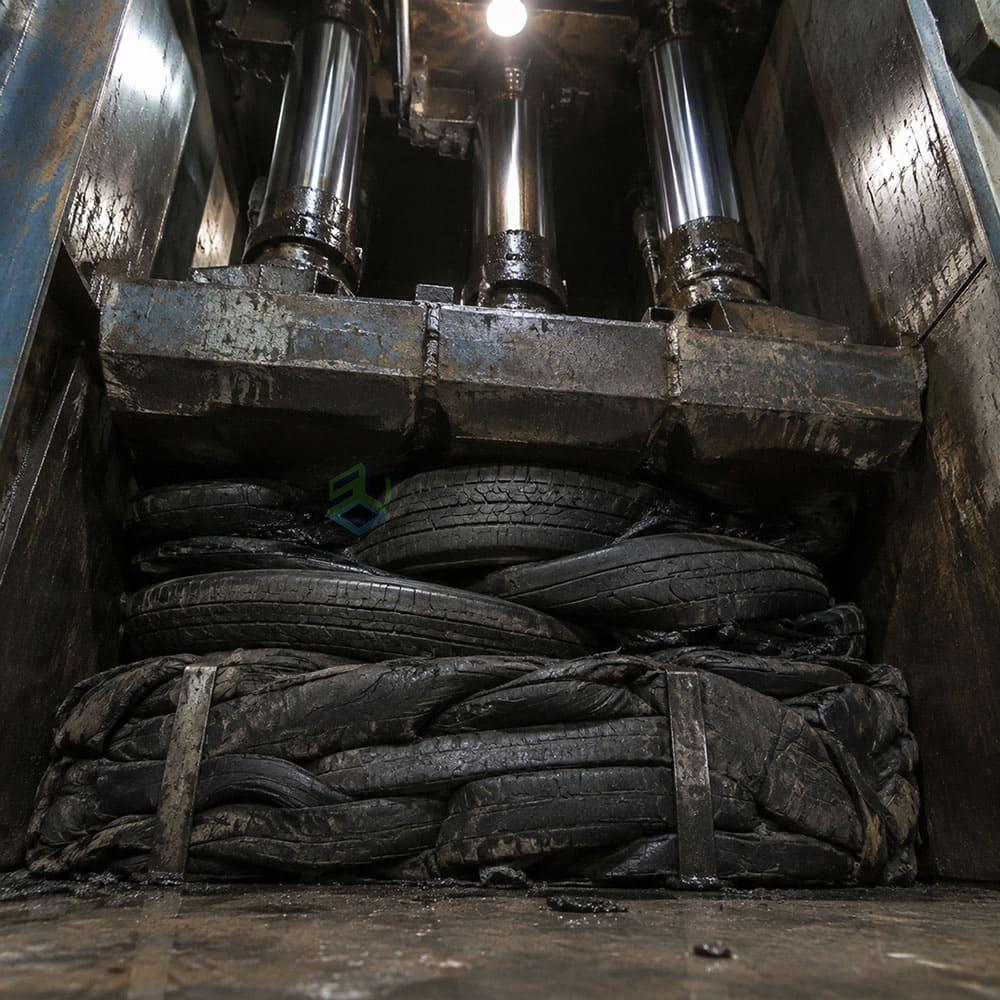
Dive deeper into the cycle impacts:
Step 1: Loading Tires
Tires—especially large ones from off-road or industrial machinery—may require manual handling or specialized loading mechanisms.2 Rimmed tires are significantly harder to position and require pre-removal processes. Small-volume balers allow manual loading, while high-throughput models often include conveyor feeds for efficiency.
Step 2: Hydraulic Compression
Balers compress tires into bales using hydraulic cylinders that exert immense pressure.3 However, compression isn’t universal: the machine’s rated force must align with tire density, size, and type. For instance:
- Passenger tires generally compress uniformly.
- Truck or industrial tires may require higher force.
- Rimmed tires pose challenges, often needing pre-processing.
Step 3: Bale Restraint or Tying
The compressive stage doesn’t end at force. Bales must be tied or restrained securely—often using metal or wire ties—to maintain integrity during transportation and storage.4 Some materials resist compaction, requiring extra restraints, further influencing machine configuration.
Step 4: Ejecting Finished Bales
Efficient bale removal ensures uninterrupted workflow. Ejection mechanisms vary across models—manual, semi-automatic, or fully automated—all chosen based on throughput volume and material handling needs.
Can one tire baler handle all tire types?
Different tire types—car, truck, industrial, and rimmed tires—pose distinct challenges for compression, tying, and loading. No single tire baler is universally suited for all applications.5
No, one tire baler cannot handle every type of tire due to differences in size, density, rim presence, and loading requirements. Buyers must select equipment matched to their specific tire recycling or waste management needs.
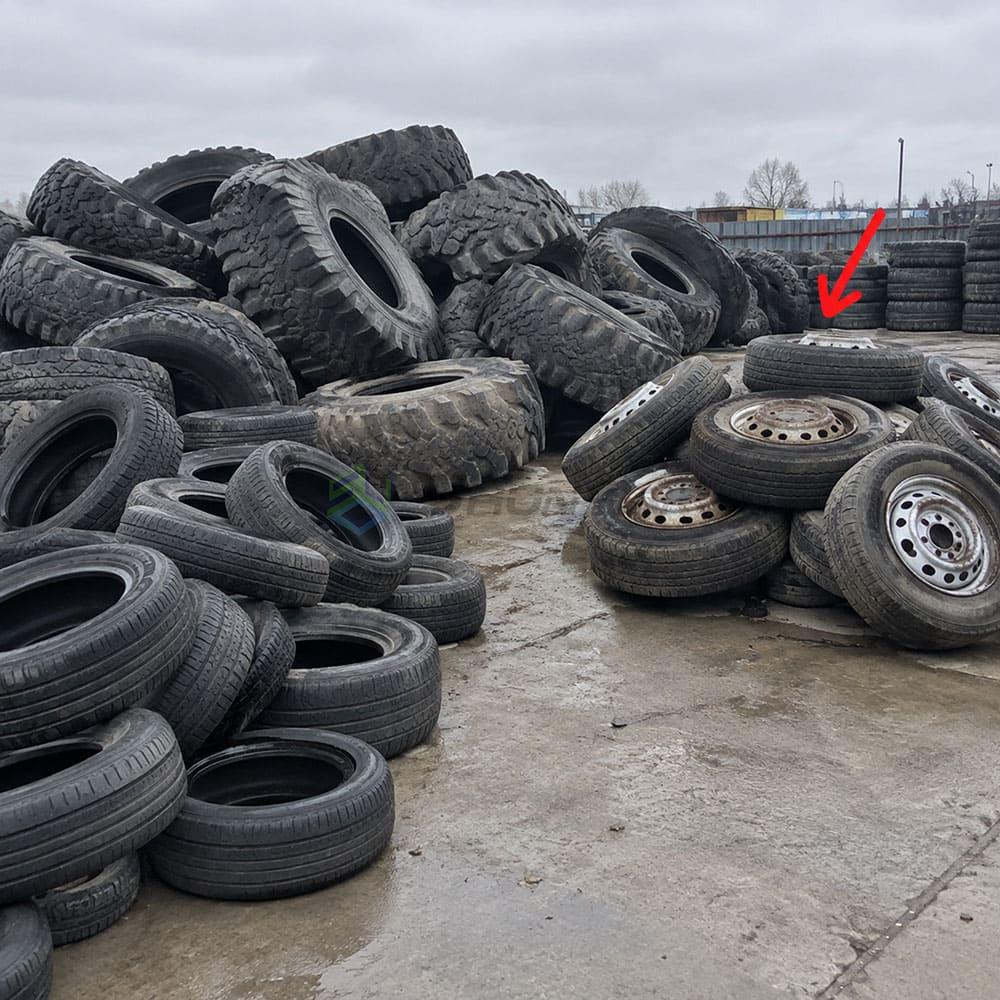
Dive deeper into tire-specific considerations:
Size and weight differences
Passenger tires are significantly smaller and less dense than industrial machinery tires. The compression force needed—and the baler’s chamber dimensions—must align with these variations. Baling overly large tires in machines designed for standard car tires risks operational inefficiency or equipment damage.
Rimmed vs. rimless tires
Rimmed tires present a substantial challenge; rims require removal before baling, as they can damage equipment. Some balers are specifically configured to process tires post-rim removal, while others focus solely on rimless variants.
Compression compatibility
Buyer inquiries often overlook one critical factor: different rubber compositions affect compressibility. Harder tires, such as those used for heavy-duty vehicles, demand more hydraulic force and cause increased wear, influencing long-term maintenance considerations.6
How does throughput affect machine selection?
Throughput—the number of tires a baler can process within a given timeframe—directly influences machine size, automation level, and pricing.7 Misjudging throughput risks operational inefficiency or underutilized investment.
Throughput impacts machine selection as tire recycling operations require balers capable of processing daily or hourly volumes efficiently. Buyers should balance force-rated models to match their tire accumulation rates and desired bale output.
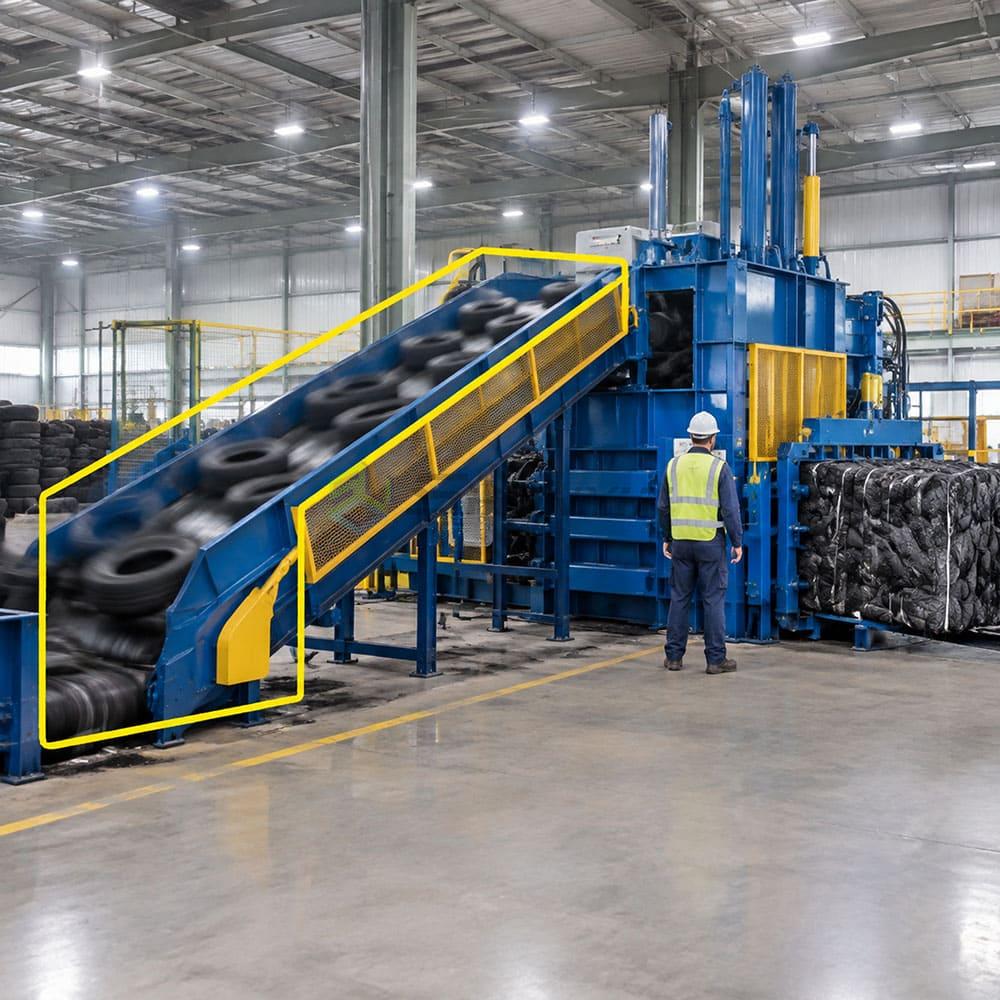
Dive deeper into throughput matching:
Volume estimation
Start by estimating daily or hourly tire accumulation. Small operators compress fewer tires manually, while large facilities typically demand high-efficiency balers with conveyor feeds and automated tying systems.
Cycle duration
A tire baler’s compression cycle typically ranges from 60 to 120 seconds, depending on material density and machine type.8 Calculate total cycle times relative to your accumulation rates for efficient operation matching.
Automation for speed
Fully automated balers optimize throughput by reducing manual intervention during loading, tying, and ejecting.9 These systems, however, require higher investment—a choice dependent on operational scale.
What defining factors shape bale specifications?
Each industry has unique bale requirements for storage, transport, or downstream recycling. Bale size, weight, tying methods, and compression density should reflect specific use cases—not just force rating.
Bale specifications depend on transport and downstream recycling demands, including size constraints, weight limits, tying security, and density standards. These factors define machine configuration and compression strategy.
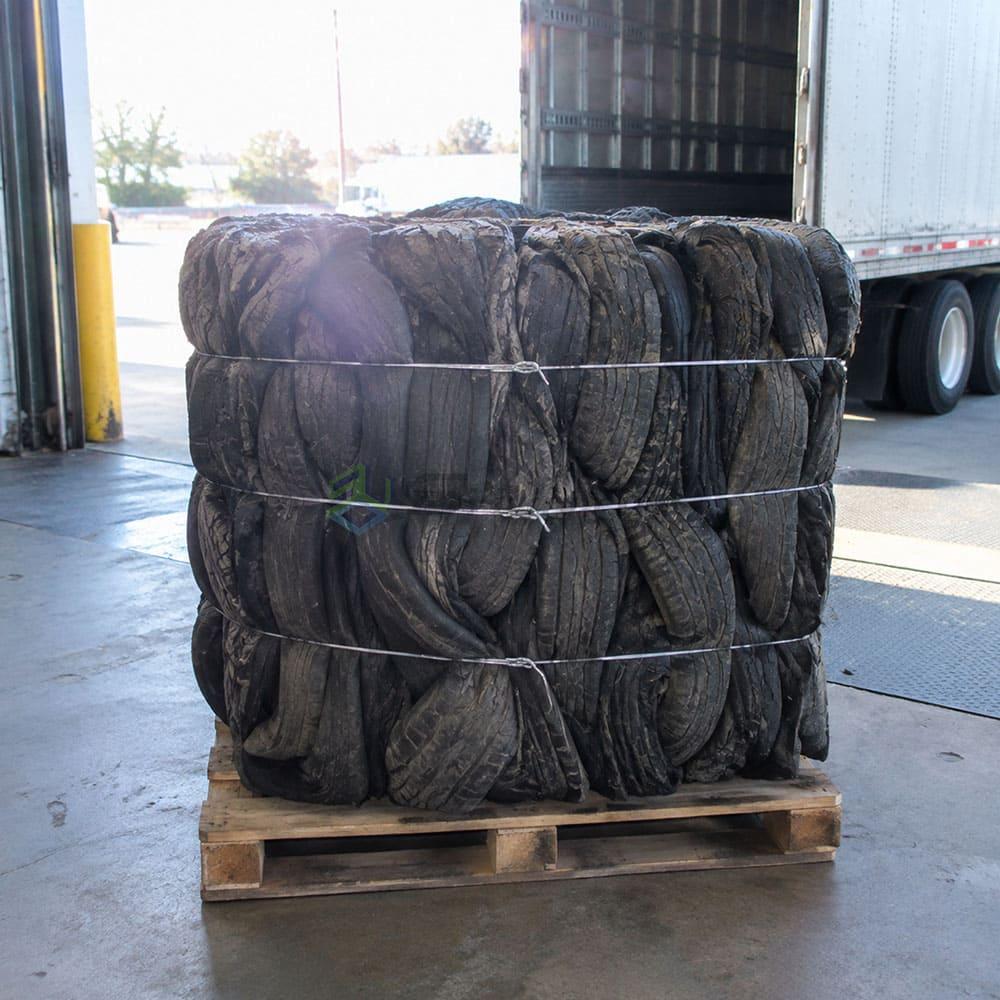
Dive deeper into bale outcomes:
Transport efficiency
Dense, uniform bales maximize truckload efficiency, reducing transportation costs.10 Define size specs that comply with shipping dimensions while optimizing bale stacking.
Downstream recycling
Some recycling facilities require specific bale formats to fit their shredders or processors. Match baler configurations to downstream acceptance criteria to avoid processing delays.
Tying methods
Metal ties or wire restraints secure compressed bales, especially critical for heavier or high-density material. Confirm tying compatibility with your storage and transport methods, factoring weight shifts during movement.
Bale consistency
Uniform bale density ensures predictable performance for further recycling processes, minimizing rework or waste during material handling.
Frequently Asked Questions
Can tire balers process tires with rims?
No, most tire balers cannot compress rimmed tires effectively. Rims must be removed beforehand to prevent equipment damage and ensure consistent bale density.11 Specialized balers may include configurations for rim processing at an additional cost.
What compression force do I need for industrial tires?
Industrial tires require higher compression force than car or truck tires due to their density. Match the machine’s rated hydraulic force to the size and density of the tire type for efficient processing.
Are manual balers suitable for small operations?
Yes, manual tire balers are cost-effective solutions for operations with low tire accumulation rates. However, they require more labor and slower throughput compared to automated or semi-automated models.
Conclusion
Understanding how a tire baler works—beyond compression mechanics—helps you match equipment to your specific operational needs. Factors like tire type, rim presence, throughput volume, and bale requirements play critical roles in machine selection. To ensure productive and efficient recycling, consult with manufacturers or suppliers to verify specifications and tailor configurations to your material-handling realities.
Ready to explore tire baler options for your facility? Contact us for expert advice and customized solutions tailored to your recycling challenges!
"Baling Solid Waste to Conserve Sanitary Landfill Space, A ...", https://nepis.epa.gov/Exe/ZyPURL.cgi?Dockey=9100FLI3.TXT. Technical descriptions of tire-baling systems identify material loading, hydraulic compaction, bale restraint, and removal or ejection as the principal stages of operation. Evidence role: mechanism; source type: institution. Supports: A technical or institutional source should describe the principal stages used to form and remove compressed tire bales.. Scope note: The precise sequence and degree of automation may differ among baler designs. ↩
"BP-30 Tire and Rim Safety", https://www.msha.gov/sites/default/files/Alerts%20and%20Hazards/BP%20Cards/BP-30%20Tire%20and%20Rim%20Safety.pdf. Occupational-safety guidance recognizes that large off-road and industrial tires can exceed safe manual-handling limits and may require mechanical lifting or positioning equipment. Evidence role: general_support; source type: government. Supports: Occupational-safety guidance should document the handling hazards associated with large, heavy tires and the use of mechanical aids.. Scope note: Such guidance establishes the handling need but may not address loading into tire balers specifically. ↩
"Design, Analysis and Fabrication of Hydraulic Scrap Baling Machine", https://www.academia.edu/101322561/Design_Analysis_and_Fabrication_of_Hydraulic_Scrap_Baling_Machine. Hydraulic baling presses use pressurized fluid to drive one or more cylinders, converting hydraulic pressure into the linear force that compacts material within the chamber. Evidence role: mechanism; source type: education. Supports: An engineering source should explain that hydraulic cylinders convert fluid pressure into linear force used for compaction.. Scope note: This hydraulic principle applies broadly to baling presses and is not unique to tire balers. ↩
"[PDF] Evaluate the uses for Scrap Tires in Transportation Facilities - ROSA P", https://rosap.ntl.bts.gov/view/dot/66528/dot_66528_DS1.pdf. Waste-tire handling guidance describes securely bound bales as necessary for maintaining bale stability during lifting, storage, and transportation. Evidence role: general_support; source type: government. Supports: Waste-management or transport guidance should document the use of binding materials to preserve bale stability during handling and shipment.. Scope note: Acceptable binding material and the required number of ties vary with bale mass, dimensions, and applicable transport rules. ↩
"User Guidelines for Waste and Byproduct Materials in Pavement ...", https://www.fhwa.dot.gov/publications/research/infrastructure/structures/97148/st1.cfm. Technical guidance on waste-tire processing treats equipment selection as dependent on tire dimensions, construction, feed preparation, output specifications, and the intended recovery or disposal route. Evidence role: expert_consensus; source type: institution. Supports: Institutional guidance should show that waste-tire processing systems must be selected according to feedstock characteristics and downstream requirements.. Scope note: This supports application-specific selection but does not prove that no configurable baler can accommodate multiple tire categories. ↩
"[PDF] Fibers From Recycled Tire as Reinforcement in Hot Mix Asphalt", https://static.tti.tamu.edu/swutc.tamu.edu/publications/technicalreports/167453-1.pdf. Mechanical studies associate greater tire stiffness and reinforcement with increased resistance to deformation, while waste-tire processing research identifies reinforced feedstocks as a contributor to tool and equipment wear. Evidence role: mechanism; source type: paper. Supports: Research should relate tire stiffness and reinforcement to deformation resistance and, separately, abrasive or impact wear in tire-processing machinery.. Scope note: Evidence from shredding or cutting machinery may only contextualize wear in balers and does not quantify baler maintenance requirements directly. ↩
"Material Recovery Facilities for Municipal Solid Waste", https://nepis.epa.gov/Exe/ZyPURL.cgi?Dockey=30004DDZ.TXT. Recycling-facility design literature treats required throughput as a primary determinant of equipment capacity and automation, with higher-capacity automated systems generally involving greater capital requirements. Evidence role: general_support; source type: research. Supports: Facility-design research should establish that processing capacity is a principal input when selecting equipment scale and automation.. Scope note: The relationship is general to processing facilities; actual tire-baler prices also depend on force rating, controls, chamber design, and regional market conditions. ↩
"Full Scale Monitoring for Assessment of Exothermal Reactions in ...", https://sites.utexas.edu/zornberg/wp-content/uploads/sites/5286/2026/02/Wappett_Zornberg_2006.pdf. Published performance data for tire-baling equipment report cycle times on the order of one to two minutes under specified operating conditions. Evidence role: statistic; source type: research. Supports: A comparative performance study or independently documented technical dataset should report measured compression-cycle durations for tire balers.. Scope note: Cycle-time definitions may exclude loading, tying, or ejection, and the stated range should not be generalized beyond the tested machines and materials. ↩
"(PDF) The Design and Fabrication of a Horizontal Hand Baler", https://www.academia.edu/65946065/The_Design_and_Fabrication_of_a_Horizontal_Hand_Baler. Research on materials-handling automation indicates that mechanized feeding, binding, and discharge can reduce labor-dependent cycle delays and increase effective throughput. Evidence role: mechanism; source type: paper. Supports: Comparative operations research should show that automating handling and binding steps can reduce labor-dependent delays and increase effective processing capacity.. Scope note: The magnitude of improvement depends on upstream supply, downtime, maintenance, and whether automated stages are the facility's actual bottleneck. ↩
"[PDF] Feasibility of Whole-plant Corn Logistics for Biobased Industries", https://etd.ohiolink.edu/acprod/odb_etd/ws/send_file/send?accession=osu1650586951648735&disposition=inline. Waste-logistics studies show that increasing shipment density can improve vehicle capacity utilization and reduce transport requirements when loads are constrained primarily by volume. Evidence role: mechanism; source type: paper. Supports: Logistics research should show that compaction improves payload utilization when low-density material would otherwise reach a vehicle's volume limit before its weight limit.. Scope note: Denser bales do not necessarily reduce costs when legal payload weight, axle limits, bale dimensions, or handling constraints are already controlling. ↩
"Scrap Tires - Ohio Environmental Protection Agency", https://epa.ohio.gov/scraptires.aspx. Waste-tire processing guidance commonly separates tires from wheels before compaction because metal rims alter the feed geometry and can exceed the design conditions of equipment intended for rimless tires. Evidence role: general_support; source type: government. Supports: A waste-tire processing source should document rim removal as a feed-preparation step for equipment not designed to compact tires containing wheels.. Scope note: This is not universal: equipment expressly engineered for tires on rims may use different preparation requirements. ↩